


How to Build a High-Performance Inbound Call Center: The Strategic 2026 Guide

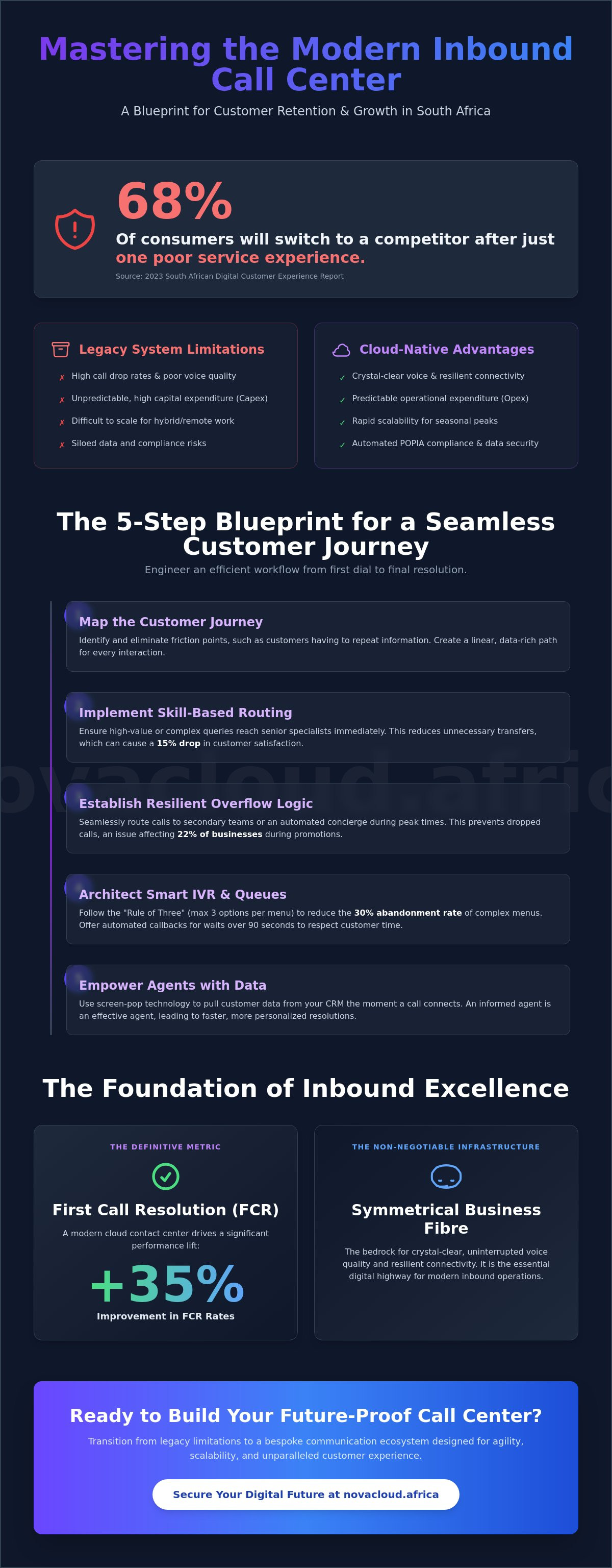
According to the 2023 South African Digital Customer Experience Report, 68% of local consumers will switch to a competitor after just one poor service experience. You've likely felt the pressure of maintaining high standards while battling high call drop rates on legacy systems that weren't built for a hybrid world. It's difficult to scale your call center inbound operations when unpredictable PBX costs and poor voice quality are actively eroding your customer's trust. We agree that your business deserves a communication backbone as ambitious as your growth targets.
This guide provides the strategic blueprint to master modern inbound operations, from intelligent routing to resilient, cloud-native infrastructure. You'll learn how to transition from legacy limitations to a scalable model that delivers crystal-clear voice quality across the continent. We're moving beyond simple connectivity to create a seamless customer experience that empowers your team. This roadmap offers the clarity needed to start a new chapter in operational efficiency and secure your digital future in the South African market.
Key Takeaways
- Discover how shifting from legacy hardware to a resilient cloud-native environment transforms your call center inbound operation into a powerful engine for brand authority.
- Master the 5-step blueprint to map seamless customer journeys and configure intelligent IVR systems that eliminate friction from dial to resolution.
- Learn why symmetrical business fibre is the non-negotiable foundation for crystal-clear voice quality and resilient connectivity across the South African market.
- Shift your focus toward First Call Resolution (FCR) as the definitive metric for measuring inbound success and long-term customer retention.
- Explore how bespoke communication ecosystems and custom VPS hosting empower your business to scale with the precision and agility of a strategic partner.
Defining the Modern Inbound Call Center Ecosystem
The era of dusty server rooms and tangled copper wiring has ended. By 2026, the traditional Call centre has evolved into a cloud-native intelligence hub. This shift isn't merely a technical upgrade; it's a fundamental reimagining of how businesses connect with their audience. Legacy hardware often traps data in silos, but modern environments thrive on seamless integration. Inbound operations now serve as the primary frontline for brand authority. While outbound teams chase leads, the call center inbound team protects the revenue you've already earned. Transitioning from a traditional call center to a unified contact center typically results in a 35% improvement in first-call resolution rates. This evolution relies on a resilient architecture where Hosted PBX acts as the central nervous system, routing queries with precision and ensuring that no customer is left in a digital vacuum.Inbound vs. Outbound: A Strategic Distinction
Inbound centers focus on high-value problem-solving and service-to-sales transitions. The goal isn't just to end the call, but to deepen the relationship. Customer Experience (CX) has replaced average handle time as the primary KPI, with 82% of South African consumers stating they will switch brands after just two poor service encounters. For the South African SME, a high-performance inbound call center is a strategic asset that transforms reactive support into a proactive engine for regional growth.The Business Case for Cloud-Native Inbound
Moving to the cloud eliminates the heavy "Capex" associated with physical server infrastructure. You no longer need to invest R500,000 in hardware that depreciates the moment it's unboxed. Cloud-native solutions offer:- Rapid Scalability: Add ten or a hundred agents in minutes to handle seasonal peaks without ordering new lines.
- Financial Agility: Shift from unpredictable repair costs to a transparent, per-seat Opex model.
- Resilient Compliance: Automated tools ensure POPIA compliance in call recording and data handling, protecting you from the legal risks of South Africa's strict privacy laws.
Designing Your Inbound Workflow: A 5-Step Blueprint
Efficiency isn't accidental; it's engineered. For a South African call center inbound strategy to succeed in 2026, you need a blueprint that prioritizes the caller's time and the agent's focus. Start by mapping every touchpoint from the initial ring to the final resolution. Identify where friction occurs. If a customer is forced to repeat their ID number three times across different departments, your workflow is failing the journey. High-performance centers eliminate these redundancies by creating a linear, data-rich path for every interaction.
Implement skill-based routing to ensure high-value queries reach your senior specialists immediately. This reduces unnecessary transfers, which currently account for a 15% drop in customer satisfaction scores in regional retail sectors. You must also set up resilient overflow logic. If your primary hub reaches capacity, calls should seamlessly route to a secondary team or an automated concierge. This prevents the "dropped call" syndrome that affects 22% of local businesses during peak promotional periods. Thinking ahead about after-hours logic ensures that even at 2:00 AM, a customer can self-serve or schedule a callback, keeping your lead pipeline active around the clock.
Architecting the IVR and Queue Logic
Modern IVR design requires a minimalist approach. Follow the "Rule of Three": never offer more than three options per menu level. This prevents cognitive overload and reduces the 30% abandonment rate often seen in complex menus. Integrate call center best practices by using queue announcements that provide honest, real-time wait estimates. If the wait exceeds 90 seconds, offer an automated callback feature. This respects the customer's schedule and flattens your traffic spikes without requiring additional staff. It's a simple shift that transforms a frustrating wait into a controlled, professional experience.
Data Integration and Agent Empowerment
Agents perform best when they aren't flying blind. Screen-pop technology is essential; it pulls data from your CRM the moment a call connects. By connecting Hosted PBX systems to your customer database, you eliminate the "How can I help you?" fatigue. Agents see the caller's history, open tickets, and previous purchase behavior instantly. This integration allows for mid-shift adjustments based on real-time analytics, helping managers reallocate resources as call volumes shift. When your team has the right data, they move from being reactive problem-solvers to proactive brand ambassadors. You can explore how these integrated cloud solutions sharpen your operational edge.
Essential Infrastructure for Inbound Excellence
Building a world class call center inbound environment in South Africa requires more than just a talented team; it demands a resilient technical foundation. By 2026, the gap between basic connectivity and professional grade infrastructure has become a primary driver of customer satisfaction. High performance centers now treat their digital architecture as a strategic asset rather than a utility. This begins with a managed firewall. These devices don't just protect against external threats; they act as traffic wardens, ensuring that voice data always takes priority over background updates or web browsing. Without this intelligent oversight, even the fastest connection can suffer from jitter during peak hours.
Connectivity: The Foundation of Voice Quality
In the South African market, the distinction between residential and business fibre is stark. Residential lines often operate on high contention ratios, meaning you share bandwidth with neighbors who might be streaming 4K video. For a professional call center inbound operation, this volatility is unacceptable. Quality of Service (QoS) tagging is the solution here. It marks voice packets as high priority, ensuring they move through the network without delay. Symmetrical upload speeds are non-negotiable for VoIP because they ensure the agent's voice stream has the same dedicated bandwidth as the incoming audio, preventing the one-way audio gaps that frustrate customers. Business fibre also carries Service Level Agreements (SLAs) that guarantee 99.9% uptime, which is vital when every minute of downtime costs your business money.
Terminal Hardware and Agent Ergonomics
While softphones offer flexibility, the Yealink T31P has emerged as the industry standard for high volume desks in 2026. This IP phone provides dedicated processing power for voice, which reduces the strain on agent computers and prevents call drops if a software application freezes. It's a reliable technical executor that delivers consistent audio clarity. Choosing the right terminal hardware is a decision that balances cost with long term productivity. Professional hardware solutions, when paired with high quality noise cancellation technology, can reduce background office clamor by up to 25 decibels. This isn't just about the customer experience; it's about the agents. Studies show that reducing acoustic stress significantly lowers agent fatigue and prevents data entry errors during long shifts. You can explore how these components integrate into a wider strategy at https://pbx.novacloud.africa.
- IP Phones: Offer superior reliability and dedicated hardware for voice processing.
- USB Headsets: Provide cost effective solutions for hybrid teams but require high quality sound cards.
- Noise Cancellation: Essential for maintaining professional standards in open plan African call centers.
- Ergonomic Design: Reduces physical strain, directly impacting staff retention rates.
Investing in this infrastructure creates a sense of quiet confidence within your team. When agents know their tools won't fail, they focus entirely on the human connection. This shift from technical frustration to operational empowerment is what defines a modern, high performance center. It's about illuminating the path to growth through technical precision.
Optimizing Performance: Metrics and Quality Assurance
High-performance call center inbound environments in 2026 demand a departure from legacy thinking. While Average Handle Time (AHT) remains a visible metric, it's often a deceptive one. Prioritizing speed over resolution frequently leads to repeat calls, which inflates operational costs and frustrates the South African consumer. Instead, visionary leaders focus on First Call Resolution (FCR) as the absolute gold standard. Data from 2024 industry benchmarks indicates that every 1% improvement in FCR yields a 1% increase in customer satisfaction scores. Resolving an inquiry the first time isn't just a service win; it's a strategic cost-saving measure that preserves brand equity.
Achieving these standards requires proactive call monitoring and whisper coaching. Supervisors can no longer wait for weekly reviews to correct course. By utilizing real-time interjection tools, managers provide "just-in-time" guidance to agents during complex R10,000+ transactions without the caller ever hearing the intervention. This creates a safety net for the agent and a seamless experience for the customer. For the distributed or remote workforce across South Africa, technical performance is just as vital as agent soft skills. Jitter and latency must be managed aggressively. A delay of more than 150ms can cause unnatural conversational overlaps, leading to a 20% drop in perceived service quality.
The KPIs of a High-Growth Call Center
Growth-oriented centers track abandonment rates with surgical precision. When abandonment rates climb above the 3% threshold, it typically signals a misalignment between staffing levels and call volume patterns. Sophisticated operators use Net Promoter Score (NPS) to capture post-call sentiment, turning qualitative feelings into quantitative data. This stat-dense reporting is essential when justifying ICT infrastructure upgrades to the board. By showing a direct correlation between reduced packet loss and increased NPS, IT managers can present a clear ROI for moving to more resilient architectures.
Ensuring 24/7 Resilience
Operational continuity in the African market requires a robust strategy against local infrastructure challenges. Cloud backups serve as the primary pillar of disaster recovery, ensuring that customer data and system configurations remain accessible even if a physical site goes dark. To combat power outages and connectivity drops, high-performance centers implement multi-homed internet lines and automated failover systems. Maintaining offsite data redundancy for call recordings is a non-negotiable necessity to ensure compliance with POPIA and provide a permanent audit trail for quality assurance.
Ready to transform your service metrics with a resilient, cloud-native foundation?
Explore NovaCloud’s Hosted PBX SolutionsScaling Your Inbound Operations with NovaCloud
Scaling a call center inbound operation in 2026 requires more than just adding more seats or increasing bandwidth. It demands a resilient, bespoke architecture that bridges the gap between global technological standards and local South African realities. NovaCloud doesn't just provide tools; we architect communication ecosystems designed for transformative growth. By integrating high-performance Virtual Private Servers (VPS), we empower businesses to host custom call center software that meets specific POPIA compliance and low-latency requirements. This ensures your voice data remains secure and your customer interactions stay crystal clear, regardless of volume spikes.
The NovaCloud Strategic Advantage
Managing multiple vendors for Fibre, PBX, and Security creates unnecessary friction and technical silos. We eliminate this complexity by acting as a single strategic partner for your entire ICT stack. This unified approach allows your leadership to focus on customer experience strategy rather than troubleshooting hardware failures. We bring global-standard infrastructure to the African continent, customizing cloud infrastructure specifically for high-performance voice applications. Our local expertise ensures that your call center inbound workflows are optimized for South African network conditions, providing a level of reliability that faceless global providers cannot match.
- Resilient Architecture: Redundant systems that ensure 99.9% uptime for critical voice services.
- Local Empowerment: Support teams that understand the South African business culture and regulatory environment.
- Scalable Solutions: Infrastructure that grows with you, from 10 agents to 1,000, without requiring massive capital expenditure.
Starting Your Digital Transformation
The transition from legacy hardware to a cloud-first model should be a journey of clarity, not confusion. We recommend beginning with a comprehensive audit of your current communication gaps. This process identifies exactly where dropped calls or poor integration are costing you revenue. Instead of a risky "big bang" migration, we advocate for pilot programs. Test your new cloud-based call center inbound workflows with small, agile teams first to prove the ROI and refine your scripts. This iterative approach builds confidence and ensures a smooth transition for your entire staff. It's time to stop fighting with outdated technology and start building a foundation for the future. Partner with NovaCloud to illuminate your digital future and experience the power of a truly modern communication partner.
Charting Your Course Toward Operational Excellence
Building a high-performance call center inbound operation for 2026 requires more than just basic connectivity. It demands a fusion of resilient infrastructure and strategic foresight. Success hinges on a blueprint that prioritizes zero-latency voice and strict POPIA compliance to protect customer trust. South Africa's Global Business Services sector is projected to support 500,000 jobs by 2030, making technical precision a non-negotiable requirement for local growth. You've seen how enterprise-grade Yealink hardware and Symmetrical Business Fibre eliminate communication barriers. Now, it's time to solidify your market position with a partner that understands the African landscape.
NovaCloud Africa provides the resilient architecture needed to scale. Our POPIA-compliant cloud recording solutions ensure your data remains secure while our zero-latency voice solutions keep your conversations fluid. Don't let legacy systems stall your progress. Architect your inbound excellence with NovaCloud Africa today. The future of your digital transformation starts with a single, clear connection.
Frequently Asked Questions
What is the difference between a contact center and an inbound call center?
A call center inbound operation focuses exclusively on voice communications, while a contact center integrates multiple digital channels like email, WhatsApp, and live chat. While the traditional inbound call center remains the backbone of customer support in South Africa, 72% of modern enterprises have transitioned to contact center models to meet consumer demand for omnichannel engagement. This evolution allows your team to manage diverse touchpoints through a single, unified interface.
How much internet bandwidth does an inbound call center agent need?
An inbound call center agent requires a minimum of 100 Kbps of dedicated bandwidth for high-definition voice traffic. To ensure resilient performance during peak periods, we recommend a symmetrical fiber connection providing at least 10 Mbps for a small team of 10 agents. This allocation accounts for the 20% overhead required for signaling and background data tasks, preventing jitter or dropped calls that compromise the customer experience.
Can I run an inbound call center with remote employees in South Africa?
You can absolutely operate a high-performance inbound call center with remote employees across South Africa using cloud-native infrastructure. The local BPO sector has seen a 35% increase in remote agent adoption since 2022, supported by expanding fiber-to-the-home networks in major hubs like Johannesburg and Cape Town. We provide the secure VPN tunnels and softphone technology needed to maintain enterprise-grade security and oversight regardless of your agent's physical location.
What is the best hardware for a professional inbound agent?
Professional agents need a high-quality noise-canceling USB headset and a PC with at least 8GB of RAM to handle modern browser-based dialers. We recommend hardware from certified brands like Jabra or Poly, which reduce ambient office noise by up to 85%. Investing in dual monitors can also increase agent productivity by 20% by allowing them to view CRM data and call controls simultaneously without switching tabs.
How does Hosted PBX reduce costs for inbound call centers?
Hosted PBX systems reduce costs by eliminating the need for expensive on-site hardware and 24/7 cooling infrastructure. Businesses typically see a 40% reduction in monthly telecommunication expenses by switching to VoIP, as internal calls between branches become free and international rates are significantly lower. This scalable model shifts your technology spend from a heavy capital investment to a predictable, monthly operational expense that grows only when you do.
Is call recording mandatory for inbound centers under South African law?
Call recording isn't universally mandatory under South African law, but it's essential for compliance in the financial and legal sectors under FSR and POPIA regulations. If you choose to record, you must inform the caller at the start of the session to comply with Section 18 of the POPI Act. Implementing automated recording ensures you have a verifiable audit trail for 100% of your interactions, protecting your business against disputes and liability.
What happens to my inbound calls if the internet goes down?
Your calls are automatically rerouted to a backup fiber line or a 5G LTE failover connection to ensure zero downtime. We configure your cloud architecture with automated redundancy that detects a primary link failure in less than 3 seconds. In extreme cases, calls can be instantly diverted to agent mobile devices or an alternative branch, maintaining your brand's commitment to availability even during local infrastructure challenges.
How do I integrate my CRM with my inbound call center software?
You integrate your CRM with your call center inbound software using native APIs or pre-built connectors for platforms like Salesforce or Zoho. This connection enables "screen pops" that display customer history the moment a call arrives, reducing average handle time by approximately 15 seconds. By syncing data in real-time, your agents skip the repetitive discovery phase and move directly into solving the customer's specific needs with total clarity.
