


M365 License Management: A Strategic Template for South African Enterprises

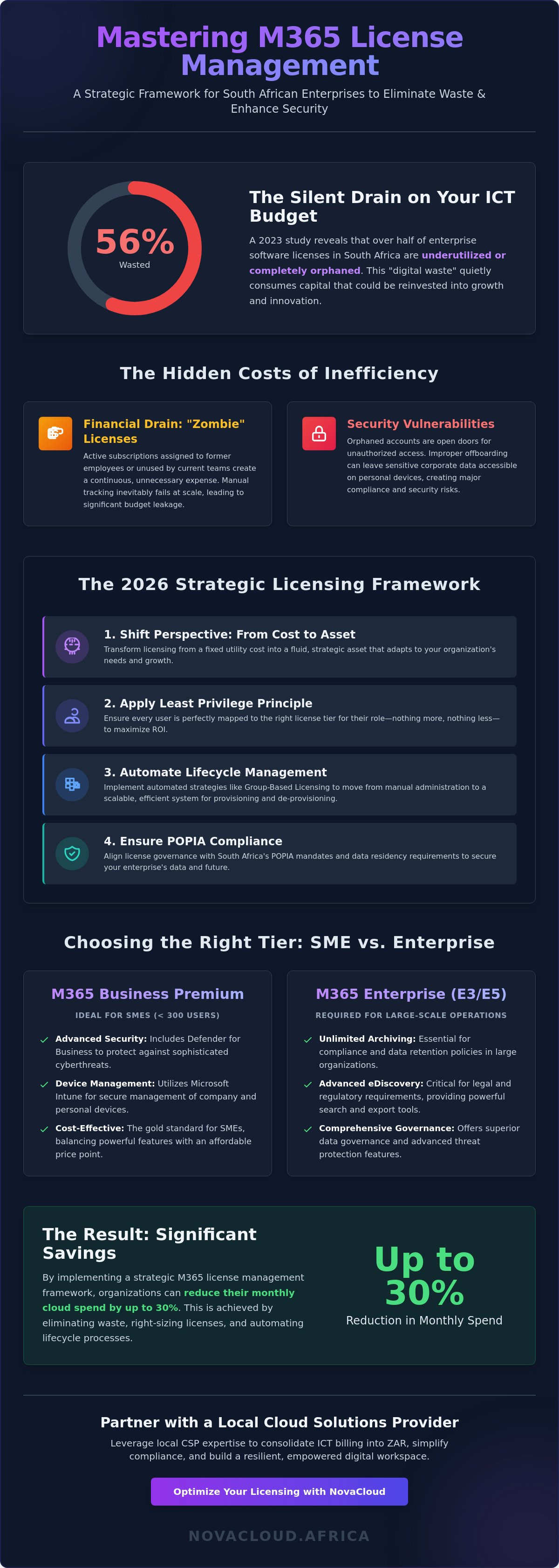
What if 56% of your monthly ICT budget was quietly draining into the void? In South Africa, where every Rand counts toward regional growth, a 2023 CoreView study reveals that over half of enterprise software seats are underutilized or entirely orphaned. This inefficiency often stems from a lack of structured M365 license management, leaving local firms paying for premium features that former employees left behind or that current teams never touch.
It's frustrating to watch your digital overhead climb while your actual productivity remains stagnant. You know that a streamlined cloud environment is the backbone of a resilient architecture, yet the complexity of shifting between Basic and Standard plans often feels like a moving target. This guide provides a strategic template to master your licensing architecture, ensuring you eliminate waste and maintain strict POPIA compliance. We'll outline a clear framework for license allocation and automated workflows, illuminating a path to reduce your monthly spend by up to 30% through smarter resource alignment.
Key Takeaways
- Eliminate "zombie" licenses and reclaim wasted budget by treating your cloud licensing as a foundational pillar of resilient digital infrastructure.
- Navigate the 2026 decision template for M365 license management to ensure every user is perfectly mapped to the right tier for maximum ROI.
- Secure your enterprise's future by aligning license governance with POPIA mandates and South African data residency requirements.
- Implement automated lifecycle strategies, including Group-Based Licensing, to transition from manual administration to scalable, high-impact growth.
- Leverage local CSP expertise to consolidate ICT billing into ZAR, simplifying your path toward a unified and empowered digital workspace.
The Strategic Architecture of M365 License Management
Digital infrastructure isn't just about hardware or connectivity. It's about the software ecosystem that powers your team every day. In the South African context, M365 license management has evolved into a cornerstone of operational efficiency. Many enterprises view licensing as a fixed utility cost, like electricity or water. This perspective ignores the dynamic nature of modern work. Effective management transforms software from a static expense into a fluid, strategic asset that adapts to your organizational pulse.
For many South African SMEs, "zombie" licenses represent a silent drain on capital. These are active subscriptions assigned to users who no longer require them or have left the company entirely. When you scale from 50 to 500 employees, manual tracking through spreadsheets inevitably breaks down. This fragmentation leads to over-provisioning, where businesses pay for premium features that remain untouched. Shifting from simple software procurement to strategic resource allocation ensures that every Rand spent on your digital toolkit contributes directly to your bottom line. It's about ensuring your M365 license management strategy reflects your actual usage patterns rather than your best guesses.
The High Cost of Poor Management
Orphaned licenses are more than just a financial nuisance. They are significant security vulnerabilities. An unmanaged, active user account provides an entry point for unauthorized access, potentially bypassing the rigorous perimeters you've built. Integrating Software Asset Management principles into your cloud environment closes these gaps by aligning identity management with license distribution. License waste will stand as the primary drain on ICT budgets in 2026. Beyond the budget, the lack of oversight during employee offboarding means sensitive corporate data might remain accessible on personal devices long after a contract ends. Proper management ensures that when a person leaves, their access and the associated costs vanish instantly.
Architecting for Scalability
Building a resilient cloud environment requires looking beyond next month's invoice. You need a three-year growth roadmap that aligns your licensing tiers with your expansion goals. Transitioning from reactive purchasing to proactive provisioning allows your IT team to deploy resources the moment a new hire starts. This agility is vital in the competitive South African landscape where speed to market is a differentiator. By leveraging scalable cloud solutions, enterprises can ensure their infrastructure supports transformative growth without the friction of legacy procurement cycles. This shift defines a modern, cloud-ready organization that is prepared for the future of work.
The M365 License Selection Framework: A 2026 Decision Template
Strategic M365 license management isn't a procurement task; it's an architectural discipline. In the South African enterprise space, where connectivity costs and data sovereignty under PoPIA remain top of mind, over-provisioning is a silent drain on capital. Most organizations waste roughly 15% of their annual software spend on features that users never touch. Effective management starts by applying the "Least Privilege" principle to licensing. This ensures users receive exactly the tools they need for their specific roles, nothing more and nothing less.
A robust M365 License Selection Framework balances immediate cost-efficiency with long-term security requirements. By 2026, the gap between basic productivity and advanced threat protection has widened. Selecting a tier isn't just about whether a user needs Excel; it's about whether that user's data requires automated sensitivity labeling or advanced identity protection. For South African firms, this often means moving away from a "one-size-fits-all" approach toward a hybrid licensing model that mixes tiers across the workforce.
SME vs. Enterprise: Finding the Sweet Spot
The 300-user threshold remains the critical pivot point for South African businesses. Microsoft 365 Business Premium has become the gold standard for SMEs, offering sophisticated security features like Defender for Business and Intune. However, as organizations scale toward the 2026 digital maturity model, the shift to Enterprise (E3 or E5) plans becomes mandatory for those requiring unlimited archive storage and advanced eDiscovery. If you're currently evaluating where your growth trajectory meets these technical requirements, our Architect’s Guide to Microsoft 365 Business Licensing provides a deep-dive analysis of these specific tier transitions within the local market.
The License Tier Decision Matrix
Precision in M365 license management requires a role-based access control (RBAC) approach to software. You can optimize your monthly ZAR spend by categorizing your workforce into three distinct profiles:
- Power Users: Executives and analysts who require the full desktop suite, advanced Power BI analytics, and high-level security (M365 E5).
- Standard Knowledge Workers: Employees who need core collaboration tools and robust device management (Business Premium or E3).
- Frontline Workers: Staff in retail, logistics, or manufacturing who primarily consume information. The M365 F3 plan is the most efficient choice here, providing mobile-first access to Teams and SharePoint without the high cost of desktop application rights.
This matrix prevents the common mistake of paying for premium desktop features for staff who only use mobile devices or web browsers. Implementing such a granular structure allows you to invest those savings back into modern cloud solutions that drive actual business growth. It's about building a lean, resilient digital foundation that empowers your team without inflating your balance sheet.
License Lifecycle Management: From Provisioning to Optimization
Effective M365 license management isn't a static task; it's a continuous cycle that aligns your digital tools with your evolving business goals. In the South African market, where exchange rate fluctuations can impact IT budgets, precision is everything. You need a structured approach to ensure every cent spent on a subscription delivers tangible value. This lifecycle approach moves your organization away from reactive purchasing toward a model of lean, resilient growth.
- Step 1: Conduct a comprehensive audit of current license utilization to identify "zombie" accounts or duplicate assignments that drain resources.
- Step 2: Implement Group-Based Licensing in Microsoft Entra ID to link permissions directly to departmental roles and security groups.
- Step 3: Automate the offboarding process to reclaim licenses immediately when an employee departs, preventing "seat leak" and unnecessary costs.
- Step 4: Establish a quarterly review cycle for usage analytics to pivot resources toward high-growth departments and adjust seat counts.
- Step 5: Consolidate billing through a local CSP partner to pay in ZAR and simplify tax compliance while gaining expert local support.
Automating the Mundane
Manual provisioning is a drain on your IT talent and a risk to your security posture. By leveraging Microsoft Entra ID for dynamic group assignments, you can ensure that a new hire in finance automatically receives the correct license and specific app access without a single helpdesk ticket. This shift reduces the burden on your technical teams, allowing them to focus on high-level architecture rather than administrative minutiae. Automation reduces human error in license assignment by up to 40%.
Usage Analytics and ROI
Paying for a license is only half the battle; the real victory lies in adoption. Many South African enterprises find that while they pay for premium tiers, their teams only use email and basic storage. Identifying underutilized apps within the ecosystem allows you to target training where it's needed most. We recommend encouraging the adoption of M365 collaboration tools to maximize value and drive a cohesive digital culture.
Calculating the true ROI of your Microsoft investment requires looking beyond the monthly invoice. You've got to measure the time saved through integrated workflows and the cost avoided by consolidating legacy third-party software into your existing M365 tenant. When M365 license management is handled with this level of strategic depth, the cloud becomes a catalyst for regional empowerment rather than just another line item on the balance sheet.
The South African Compliance Layer: POPIA and Governance
Governance in the South African context isn't a suggestion; it's a statutory requirement. Since the Protection of Personal Information Act (POPIA) became fully enforceable in July 2021, the Information Regulator has increased its scrutiny of how local enterprises handle citizen data. Strategic M365 license management provides the technical framework to meet these legal obligations without stifling operational speed. It ensures that data residency remains within South African borders, specifically leveraging Microsoft's local data centers in Johannesburg and Cape Town to maintain sovereignty. By selecting the correct licensing tier, businesses can automate the classification of personal information, ensuring that "special personal information" as defined by the Act receives the highest level of encryption and restricted access.
POPIA-Ready Digital Workspaces
A clean POPIA audit depends on your ability to prove who has access to what data at any given second. Many South African firms struggle with "ghost users," which are accounts belonging to former employees that remain active due to poor offboarding processes. Effective license management solves this by tying data access directly to the license lifecycle. When a license is revoked, access to the digital workspace is terminated instantly. This prevents unauthorized movement of personal information, a critical requirement under Section 19 of POPIA. Organizations using higher-tier licenses can automate these audits, using built-in tools to track data sensitivity and movement across the entire national workforce. This visibility is the difference between a compliant operation and a R10 million fine.
Security as a Licensing Feature
For the approximately 40% of South African corporate employees now working in hybrid or remote models, security can't be confined to the office walls. Licensing tiers that include Microsoft Intune and Endpoint Manager allow businesses to enforce strict security policies on mobile devices. This ensures that personal information is encrypted and that remote wipes can be performed if a device is stolen in transit. While these tools secure the endpoint, they work best as part of a layered defense. Robust Managed Firewalls complement these M365 features by securing the perimeter, creating a resilient architecture that protects both the cloud environment and the local network. This intersection of M365 license management and infrastructure security is what defines a mature, compliant enterprise in the modern African market.
Implementing Information Rights Management (IRM) through correct licensing allows you to control what happens to data even after it leaves your tenant. You can prevent users from printing, forwarding, or copying sensitive South African customer data, ensuring that your governance policies remain intact regardless of where the file travels. This level of control is essential for maintaining trust in a digital economy that demands both transparency and absolute privacy.
True digital transformation requires a partner who understands the local regulatory landscape as well as the global tech stack. We help you align your infrastructure with your legal obligations.
Partnering for Growth: NovaCloud’s Managed Licensing Model
Effective M365 license management isn't just a procurement task; it's a strategic move toward operational resilience. Many South African enterprises are moving away from direct Microsoft billing to embrace the Cloud Solution Provider (CSP) model. This shift isn't merely about who processes the payment. It's about securing a partner who understands the nuances of the local business environment, from exchange rate fluctuations to regional compliance requirements. By choosing a local partner, you ensure your IT spend stays within the South African economy while gaining a level of technical intimacy that global ticket systems can't replicate.
Consolidating your ICT billing brings immediate clarity to your financial forecasting. When you bundle Fibre, PBX, and M365 into a single monthly invoice, you eliminate the administrative burden of managing multiple vendors across different time zones. This unified approach allows for better oversight of your digital infrastructure. It’s a move from fragmented services to a cohesive ecosystem where every component is designed to support your growth.
The Local Advantage
Navigating the global tech landscape requires a guide who speaks your language and understands your market's unique pressures. We provide personalized support that moves beyond faceless automated responses. Our team acts as an extension of your own, offering dedicated assistance for complex migration projects that might otherwise stall. We specialize in creating synergy between your productivity tools and your communication infrastructure. By integrating your environment with Hosted PBX systems, we help you build a unified communications hub that keeps your team connected, whether they're in Sandton or working remotely in the Cape. This integration can improve workflow efficiency by as much as 30% for distributed teams.
Starting Your Optimization Journey
Your path to a leaner, more efficient cloud environment starts with a comprehensive licensing audit. It's common for South African firms to discover they're paying for 15% more licenses than they actually have active users. We identify these redundancies immediately, reallocating resources to where they'll have the most impact. Our roadmap for M365 license management focuses on transitioning your business to a managed environment with zero downtime. We handle the technical heavy lifting, allowing your leadership to focus on high-level strategy rather than license counts.
NovaCloud’s vision is to empower African businesses through absolute cloud clarity. We believe technology should be a catalyst for regional empowerment, not a source of confusion or hidden costs. Our "Nova" approach illuminates the path forward, ensuring your digital transformation is both sustainable and scalable. It’s time to move past the complexity of traditional IT and start a new chapter of efficiency.
Contact NovaCloud to architect your optimized M365 environment and reclaim control over your digital infrastructure today.
Illuminating Your Path to Strategic Scalability
Effective M365 license management transforms a static cost center into a resilient engine for growth. By 2026, South African enterprises must bridge the gap between global technical standards and local POPIA governance requirements to remain competitive. You've now explored how a structured lifecycle approach eliminates the waste of unassigned seats while securing your digital perimeter. It's about more than just compliance; it's about building a foundation that scales with your ambition.
NovaCloud stands ready as your authorized Microsoft 365 Business Licensing partner to simplify this complexity. We combine deep South African ICT expertise with a national reach, offering the clarity of consolidated billing for your cloud, connectivity, and voice services. Our team acts as the innovative architect for your infrastructure, ensuring every Rand spent translates into measurable business value. Don't let licensing silos stall your digital transformation or cloud journey.
Architect your optimized M365 environment with NovaCloud
The future of African enterprise is bright, and we're here to help you lead it with confidence.
Frequently Asked Questions
What is the difference between M365 license assignment and provisioning?
License assignment is the act of allocating a seat to a specific user, while provisioning is the automated technical process that activates services like Exchange or SharePoint. Effective M365 license management requires understanding this distinction to ensure users actually access the tools they're assigned. If provisioning fails, the license remains active and billed, but the user stays unproductive.
How can I identify unused Microsoft 365 licenses in my tenant?
You can identify unused licenses by navigating to the Usage section within the Microsoft 365 Admin Center. Data from the last 30 to 90 days reveals which users haven't signed into specific apps. This visibility allows South African enterprises to reclaim costs by reallocating or canceling dormant subscriptions. It’s a vital step in maintaining a lean, resilient digital architecture.
Is it better to pay Microsoft directly or use a South African CSP like NovaCloud?
Partnering with a South African CSP like NovaCloud is superior because it provides ZAR-based billing and localized technical support. Paying Microsoft directly often involves fluctuating exchange rates and foreign transaction fees on credit cards. Local partners act as strategic allies, offering personalized roadmaps that global support desks can't match. This approach secures your budget against Rand volatility.
Does Microsoft 365 Business Premium include all necessary POPIA security features?
Microsoft 365 Business Premium includes essential security features like Azure Information Protection and Intune, which are foundational for POPIA compliance in South Africa. These tools allow you to encrypt sensitive data and manage mobile devices effectively. While no software guarantees compliance alone, this SKU provides the technical safeguards required by the Information Regulator for every byte of your local data.
Can I mix and match different M365 license types within one organization?
You can absolutely mix and match different license types within a single organizational tenant. This flexibility allows you to assign high-end E5 licenses to executives while providing basic F3 licenses to frontline workers. It’s a scalable solution that ensures you only pay for the specific capabilities each role requires. Mixing licenses optimizes your total cost of ownership across the entire workforce.
What happens to a user’s data in South Africa when their license is unassigned?
When a license is unassigned, Microsoft retains the user's data for a 30 day grace period before it's permanently deleted. This window is critical for South African businesses to back up or migrate files to a different storage location. After these 30 days, the data is purged from Microsoft's servers. We recommend using a resilient backup strategy to protect intellectual property during employee offboarding.
How often should a South African SME perform a license audit?
South African SMEs should perform a comprehensive M365 license management audit every 90 days. Quarterly reviews help identify license creep where subscriptions are added but never removed after staff departures. Regular audits ensure your cloud spend aligns with your actual headcount. This disciplined rhythm prevents unnecessary expenditure and keeps your digital infrastructure optimized for growth.
Can I manage M365 licenses through my local IT support partner?
You can certainly manage your licenses through a local IT support partner using delegated administration privileges. This collaborative model allows your partner to handle the granular technical details while you focus on high-level business strategy. It bridges the gap between global technology standards and local operational needs. Your partner ensures that every seat assigned contributes directly to your company's transformative growth.
