


Microsoft 365 vs Google Workspace: The 2026 Strategic Guide for SA Businesses

What if your choice between microsoft 365 vs google workspace has less to do with cloud storage and everything to do with your team's ability to work through a four hour power outage? You've likely felt the sting of unpredictable licensing fees that fluctuate with the Rand; or the sudden bottleneck of cloud-only tools when local connectivity falters. It's a common struggle for South African leaders trying to maintain a high-performance culture across distributed teams while managing tight operational budgets.
We've designed this strategic guide to move you past surface-level features and into a deep analysis of which suite offers the most resilient architecture for our unique market. You'll learn how to lock in a predictable monthly spend and secure your digital perimeter against the 24% rise in regional cyber threats reported in late 2025. We are examining the integration capabilities, offline performance, and local compliance standards that will empower your business to scale across the continent with clarity and confidence.
Key Takeaways
- Understand why your strategic decision between microsoft 365 vs google workspace is now the foundation for building a resilient, high-growth cloud infrastructure in South Africa.
- Evaluate the heavy-hitting power of Microsoft’s desktop ecosystem against the browser-first agility of Google to determine which suite aligns with your team’s unique workflow.
- Master the "Offline Reality" by learning how to safeguard productivity against load shedding and fibre outages while maintaining strict POPIA compliance.
- Navigate the complexities of licensing and migration to calculate a true total cost of ownership in ZAR, ensuring your transition is seamless and data-secure.
- Discover how the "Nova" approach brings clarity to your ICT strategy, transforming your digital workspace into a catalyst for regional empowerment and growth.
Navigating the 2026 Cloud Ecosystem: Why the Choice Matters Now
The digital workspace isn't a collection of icons on a desktop anymore. By 2026, it's evolved into the very nervous system of your enterprise. South African firms have moved beyond the tentative steps of 2020; currently, 74% of local professional services operate on hybrid-first models. Your choice between microsoft 365 vs google workspace isn't just about picking an email provider. It's about selecting the infrastructure catalyst that will define your operational resilience and your ability to scale across the continent.
We've transitioned from viewing software as a tool to seeing the cloud as an infrastructure catalyst. This shift means your choice dictates how your data flows, how your teams collaborate, and how safely you navigate the regulatory environment. In a market where agility is currency, the wrong ecosystem can become a lead weight on your growth. Choosing a platform is a high-level strategic decision that requires the precision of an architect and the vision of a leader.
Effectively communicating this strategic vision is crucial for team buy-in and a successful transition. For leaders looking to enhance their influence, you can read more.
The Core Philosophy: Microsoft’s Structure vs Google’s Agility
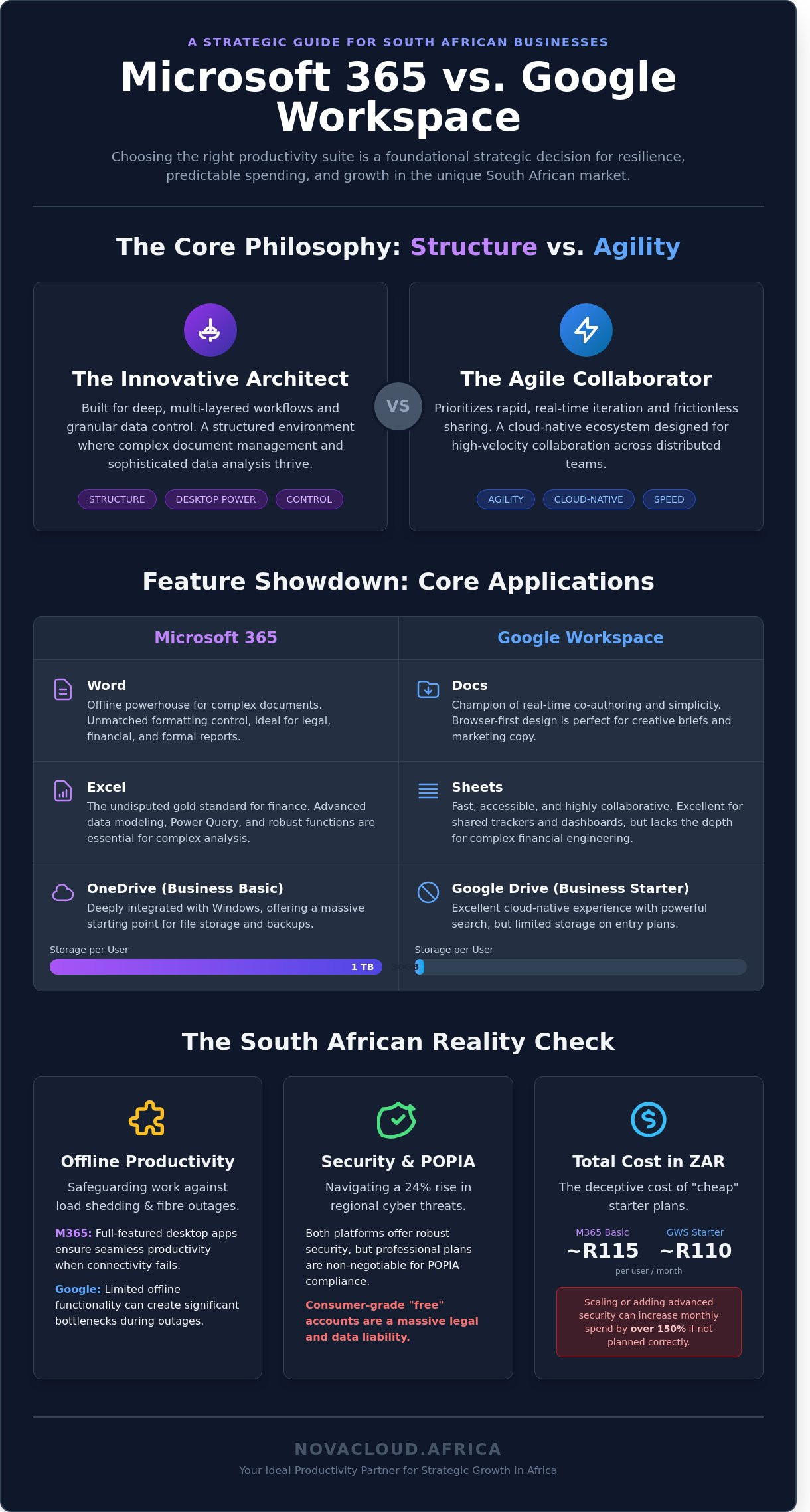
Microsoft 365 functions as the Innovative Architect's toolkit. It's built for deep, multi-layered workflows and granular data control. It provides a structured environment where complex document management and sophisticated data analysis thrive. Conversely, Google Workspace remains the champion of the Agile Collaborator. It prioritizes rapid, real-time iteration and frictionless sharing across distributed teams. When you examine a comprehensive comparison of office suite features, the technical divergence becomes clear. Microsoft offers a legacy of robust desktop power; Google offers a future of cloud-native simplicity. This decision creates an ecosystem lock-in that dictates your long-term ICT strategy, hiring profile, and security posture.
Debunking the 'Free' and 'Cheap' Myths in 2026
Relying on consumer-grade free accounts is a liability for professional South African firms. Beyond the lack of professional credibility, these accounts fail to meet POPIA compliance standards, leaving your business vulnerable to massive legal risks. Professionalism requires investment. Pricing in the local market requires a sharp eye on the bottom line:
- Microsoft 365 Business Basic: Typically starts around R115 per user per month, offering 1TB of cloud storage and professional email.
- Google Workspace Business Starter: Enters the market at approximately R110 per user per month, focusing on a 30GB storage limit.
- The Hidden Gap: While the R5 difference seems negligible, the "standard" features often hide costs. You'll frequently find that entry-level tiers lack the advanced security or archival capacities required by growing South African enterprises.
The microsoft 365 vs google workspace debate often ignores the cost of add-ons. If your operations require advanced data loss prevention or massive storage upgrades, a "cheap" starter plan can quickly become an expensive patchwork. Scaling often forces an immediate jump to higher tiers, which can increase your monthly spend by 150% if you haven't mapped your growth correctly from the start. True clarity comes from matching your infrastructure to your vision, not just your current budget.
Feature Showdown: Microsoft 365 Power vs Google Workspace Agility
Choosing between these platforms requires a deep understanding of your team's operational rhythm. By 2026, the microsoft 365 vs google workspace debate has moved beyond simple document editing. It is now a choice between two distinct philosophies of digital infrastructure. The strategic competition and AI integration between Microsoft Copilot and Google Gemini has transformed these suites into proactive partners that predict user needs and automate complex workflows. Microsoft offers a dense, feature-rich environment built for deep work, while Google prioritizes high-velocity, browser-based collaboration.
Document Creation and Advanced Data Processing
Excel remains the undisputed gold standard for South African financial sectors. For a Cape Town-based firm managing a portfolio of R500 million, the advanced data modeling and Power Query capabilities of Excel are essential for regulatory compliance. Google Sheets is fast, but it lacks the depth required for complex financial engineering. However, Google Docs leads the way for creative and marketing teams. Its real-time co-authoring is fluid and lag-free, even with twenty people editing simultaneously. The Microsoft 'Ribbon' interface offers immediate access to thousands of features for power users, whereas Google’s 'Dropdown' menus provide a minimalist UI that helps teams complete standard tasks without visual clutter.
Unified Communications and Synchronous Collaboration
Microsoft Teams has matured into a central hub that replaces the traditional intranet. It handles project management, external guest access, and internal chat within a single, resilient architecture. Google Meet, by contrast, is the king of frictionless interaction. It’s perfect for quick client catch-ups where you don't want the recipient to worry about software downloads. To achieve a truly professional communication stack, many South African businesses integrate Hosted PBX systems. This bridge ensures that your digital meetings and professional voice services function as one cohesive unit, providing a stable point of contact for your customers.
Storage Architecture and File Management
SharePoint provides the sophisticated document management and permission structures that large-scale enterprises need to stay organized. It treats files as part of a broader data governance strategy. Google Drive favors an intuitive, search-first approach that mirrors the ease of a web search. This is often more effective for smaller, agile teams that need to find assets quickly. Despite these robust internal storage options, the rise in regional data volatility means that secure cloud backups are a non-negotiable layer of your security stack. Protecting your intellectual property requires more than just a sync folder; it needs a dedicated recovery plan.
Selecting the right suite is the first step in starting your transformative growth journey with a partner who understands the local landscape.
Beyond the Apps: Security, POPIA, and the Offline Reality
South African businesses face hurdles that global counterparts rarely consider. Between Stage 6 load shedding and the 2023 undersea cable breaks that throttled local internet speeds for weeks, your choice of microsoft 365 vs google workspace must account for more than just aesthetics. It requires a resilient architecture that keeps your team productive when the grid or the fibre fails. This is where the strategic divide between desktop-centric and browser-first philosophies becomes a critical business decision.
Resilient Workflows in a Connectivity-Challenged Environment
Microsoft 365 offers a significant advantage through its full desktop suite. Your team can continue working on complex Excel models or lengthy reports during a power outage without a heartbeat of lag. Once the connection restores, OneDrive synchronizes those changes seamlessly. It's a robust solution for power users who can't afford to wait for a browser to refresh.
Google Workspace operates on a browser-first model. While its offline mode has seen updates since 2019, it remains a "lite" experience compared to its online version. Google’s offline capabilities are best suited for mobile data users or those with stable backup power (UPS) systems. For companies relying on resilient cloud infrastructure, Microsoft’s ability to process data locally provides a safety net that browser tabs simply cannot replicate during local infrastructure failures.
- Microsoft 365: 1TB of local-to-cloud synced storage per user with full offline app functionality.
- Google Workspace: Requires Chrome-specific extensions for offline use with limited file support.
- Sync Speed: Microsoft’s block-level copying only uploads changes, saving bandwidth on capped LTE connections.
Enterprise-Grade Security and Compliance
Data sovereignty is no longer a luxury. It's a legal requirement under the Protection of Personal Information Act (POPIA). Microsoft led the charge by opening data centres in Johannesburg and Cape Town in 2019, ensuring South African data stays on local soil. Google followed this momentum by launching its Johannesburg cloud region in early 2024, providing much-needed parity for local data residency.
Security architecture defines your risk profile. Microsoft Purview is a sophisticated toolset that allows administrators to automate POPIA compliance by identifying sensitive data like ID numbers or bank details across the entire organization. It's built for complexity. Google Workspace’s Security Command Centre offers a more streamlined, human-centric approach. It provides simplified admin oversight that 72 percent of small-to-medium enterprises find easier to manage without a dedicated security team.
Both platforms utilize multi-factor authentication (MFA) to block 99.9 percent of automated cyberattacks. However, the choice in the microsoft 365 vs google workspace debate often rests on your internal expertise. Microsoft provides granular control for the Innovative Architect, while Google offers a visionary, simplified path for rapid growth. At NovaCloud, we help you align these global standards with your specific local context, ensuring your digital transformation is both secure and unstoppable.
The Total Cost of Ownership: Licensing, Support, and Migration
Choosing between microsoft 365 vs google workspace requires looking far beyond the initial sticker price. While a standard license might sit between R235 and R250 per user, the true cost of ownership is defined by how these tools impact your billable hours. A 2023 productivity audit revealed that South African businesses lose roughly 21% of their operational efficiency to fragmented digital workflows. Your platform choice should act as a catalyst for growth, not a drain on your internal resources.
Currency volatility remains a massive hurdle for local enterprises. Since the Rand frequently fluctuates by 10% or more against the US Dollar within a single quarter, managing software costs becomes a moving target. Local licensing partners provide a vital buffer here. They offer predictable ZAR-based billing structures that shield your IT budget from the erratic swings of global exchange markets. Beyond the financial math, you're investing in the human element. Software only delivers value if your team adopts it. Adoption rates often stall at 30% without structured training, leaving sophisticated features untouched and your ROI unrealized.
Strategic Migration: Moving Without the Mess
Moving your entire digital infrastructure is a high-stakes operation that demands precision. A "Big Bang" switchover works for small teams of under 15 people, but larger South African firms require a phased migration to maintain stability. This approach ensures email continuity and keeps complex calendars synchronized while moving terabytes of sensitive data. Don't fall into the DIY trap; 32% of businesses attempting unassisted migrations report permanent data loss or broken file permissions. Expert IT assistance turns a potential technical crisis into a controlled, visionary evolution for your brand.
Support and Local Expertise
Global support tickets often languish in automated queues for 24 to 48 hours, a timeline that doesn't fit the rapid South African business rhythm. Local expertise means having a strategic ally who understands POPIA compliance and our unique connectivity challenges. You can achieve a resilient, unified technical stack by integrating your microsoft 365 vs google workspace decision with scalable VPS hosting. This creates a high-performance architecture where your applications and data live in harmony, backed by a team that answers the phone the moment you need clarity. This proximity ensures your digital transformation remains on track, regardless of global shifts.
Ready to stabilize your IT costs and secure your business data? Partner with NovaCloud for a seamless migration strategy today.
Strategic Alignment: Why NovaCloud is Your Ideal Productivity Partner
Choosing between microsoft 365 vs google workspace represents more than a software preference; it's the foundation of your digital estate. NovaCloud Africa operates as the Innovative Architect of this journey, moving beyond the role of a traditional vendor to become a strategic ally. We believe in the "Nova" approach, which focuses on bringing absolute clarity to the often murky waters of ICT procurement. By illuminating the technical nuances that separate these platforms, we ensure your leadership team makes decisions based on long-term scalability rather than short-term convenience.
Our methodology treats cloud integration as a structural undertaking. We don't just provision licenses and walk away. We design a resilient architecture that supports transformative growth, ensuring your chosen ecosystem integrates with your existing workflows without friction. This precision allows South African businesses to stop worrying about uptime and start focusing on market expansion. It's about creating a workspace where technology feels invisible because it works exactly as intended.
A Holistic Approach to Digital Transformation
True digital resilience requires a multi-layered strategy. NovaCloud Africa combines the power of Microsoft 365 with managed firewalls and high-speed business fibre to create a fortified perimeter for your data. This unified front eliminates the security gaps often found in fragmented setups. To fully round out your communication stack, our Hosted PBX Providers guide offers a roadmap for integrating voice services into your cloud environment. By consolidating these services, you gain a single point of accountability, which typically reduces troubleshooting cycles by 35% compared to multi-vendor environments.
Empowering Your Business Future
Preparing for the 2026 fiscal year requires an audit of your current stack today. We help you navigate the microsoft 365 vs google workspace divide by providing customized cloud roadmaps that respect South African market realities, such as varying connectivity quality and local compliance needs. Our expert licensing support ensures you aren't overpaying for features your team won't use, potentially saving your firm up to R1,200 per user annually in wasted seat costs. We provide the technical execution that allows you to scale with quiet confidence.
Ready to move past the confusion and into a state of operational excellence? You don't have to navigate these complex choices alone. Start your bright new chapter with NovaCloud Africa’s Microsoft 365 solutions and build a foundation that's ready for whatever the next decade brings.
Secure Your Competitive Edge in the 2026 Cloud Market
The 2026 digital landscape demands more than just a suite of tools; it requires a resilient foundation that balances high-level security with seamless collaboration. As South African businesses navigate POPIA compliance and the need for 99.9% uptime, the choice between microsoft 365 vs google workspace becomes a defining strategic move. Microsoft 365 provides over 1,000 security and privacy settings tailored for enterprise-grade protection. Google maintains its edge in rapid, cloud-native agility. Your decision dictates your long-term operational costs in ZAR and your team's ability to remain productive during local connectivity challenges.
NovaCloud Africa stands as your authorized Microsoft 365 Business Licensing Partner, providing the local expertise needed to transition smoothly. We combine resilient South African cloud infrastructure with expert local technical support to ensure your migration is a catalyst for growth. It's time to move past legacy limitations and embrace a future where your technology works as hard as you do. We're ready to help you illuminate the path forward.
Empower your team with professional Microsoft 365 Licensing from NovaCloud Africa
Frequently Asked Questions
Is Microsoft 365 or Google Workspace better for POPIA compliance?
Both platforms provide the necessary tools for POPIA compliance, but Microsoft 365 holds a localized advantage with its data centers in Johannesburg and Cape Town. Microsoft established these local regions in 2019, allowing South African businesses to keep sensitive personal information on local soil. Google opened its Johannesburg cloud region in 2024, which now offers similar residency benefits. Both suites provide 100% of the encryption and audit logs required by the Information Regulator.
Can I use Google Workspace offline during load shedding?
Yes, you can use Google Workspace offline by enabling the offline extension in your Chrome browser before the power goes out. This feature allows you to create and edit 100% of your Docs, Sheets, and Slides without an active internet connection. Once your power or fiber connection returns, the system automatically syncs your changes to the cloud. It’s a resilient solution for staying productive during Stage 4 or Stage 6 power cuts.
Which suite is more cost-effective for a South African SME in 2026?
Google Workspace remains the leaner entry point for SMEs in 2026, with basic plans starting at approximately R140 per user. Microsoft 365 Business Basic follows closely at roughly R125 per user, though it requires a yearly commitment to secure that rate. When evaluating microsoft 365 vs google workspace for larger teams, Microsoft often wins on value. Its R480 Business Premium tier includes advanced security tools that would cost an extra R150 per month if bought separately.
Is it possible to run a business using both Microsoft 365 and Google Workspace?
You can certainly run a hybrid environment where different departments use different platforms. About 15% of modern enterprises use this "co-existence" model to satisfy specific needs, such as creative teams preferring Google Drive and finance teams requiring Excel. You'll need a centralized identity provider like Microsoft Entra ID to manage logins across both systems. This approach ensures seamless integration while giving your staff the specific tools they need for transformative growth.
Do I need a local partner for Microsoft 365 licensing in South Africa?
You aren't legally required to use a local partner, but doing so saves you from the volatility of the ZAR to USD exchange rate. Direct billing from global providers often fluctuates monthly and includes 3.5% in hidden currency conversion fees on your credit card statement. A local Tier-1 partner provides a fixed ZAR tax invoice and local support. This partnership turns a cold technical transaction into a strategic alliance with experts who understand the African business context.
How long does a full migration from Google to Microsoft 365 typically take?
A migration for a standard SME with 50 users typically takes 14 to 21 days from planning to completion. This timeline includes 5 days for data staging, 2 days for the actual cutover, and a week of post-migration support to ensure 100% of your files moved correctly. Larger organizations with over 500 users should plan for a 3 month transition. We use automated tools to ensure your email history and folder structures remain intact during the move.
Which platform offers better security for remote teams?
Microsoft 365 offers more granular security controls for remote teams through its integrated endpoint management features. While Google uses a robust "BeyondCorp" zero-trust model, Microsoft’s system allows you to manage 100% of the physical laptops and mobile devices your staff use at home. You can remotely wipe a lost device or restrict data downloads based on the user's GPS location. This level of control provides a resilient architecture for businesses facing high cybersecurity risks.
Does Microsoft 365 include a professional VoIP or PBX solution?
Microsoft 365 includes a comprehensive cloud-based PBX system known as Microsoft Teams Phone. You can port your existing 011, 021, or 031 landline numbers directly into Teams to make and receive professional calls on your smartphone or laptop. This eliminates the need for expensive on-site hardware and reduces monthly telephony costs by up to 30%. Google Workspace offers a similar service called Google Voice, but its full enterprise features aren't yet as deeply integrated for South African business users.
