


The 2026 State of Local Cloud Infrastructure: A Strategic Trend Analysis for South African Enterprise

Why are South African CTOs trading the prestige of global cloud giants for the precision of local soil? You've likely felt the sting when a sudden 12% ZAR depreciation against the Dollar inflates your monthly billing, or when a 150ms lag disrupts a mission-critical transaction. It's a common frustration in an era where speed and fiscal predictability dictate market leadership. Relying on local cloud infrastructure has transitioned from a niche latency luxury into a mandatory pillar for operational resilience and absolute data sovereignty.
This strategic analysis demonstrates why localizing your digital core is the only way to secure sub-millisecond latency and guaranteed POPIA compliance. We'll examine the 2026 shift toward Rand-denominated billing and how a regional-first approach eliminates the "latency tax" on your innovation. You'll gain a clear roadmap to transform your ICT spend from a volatile liability into a stable engine for growth. By aligning your technical architecture with the specific demands of the African market, you don't just survive the next decade; you illuminate the path for others to follow.
Key Takeaways
- Understand the critical transition from "Global-First" to "Local-First" strategies and why local cloud infrastructure is now the foundation for South African operational resilience.
- Explore the "Latency Floor" requirements of 2026, where sub-10ms response times become the mandatory standard for real-time AI and industrial automation.
- Transition from basic POPIA compliance to strategic data residency, ensuring your enterprise data remains protected and sovereign within national borders.
- Compare the total cost of ownership between global hyperscalers and local providers to avoid unforeseen egress fees and ensure ZAR-based budget predictability.
- Apply a rigorous architect’s framework to evaluate infrastructure partners based on tier-certification, connectivity synergy, and bespoke support models.
Defining Local Cloud Infrastructure in the 2026 South African Landscape
Local cloud infrastructure represents the physical foundation of our digital economy, consisting of high-tier data centres and hardware located strictly within South African borders. The "Global-First" era, where businesses defaulted to northern hemisphere servers by habit, has been replaced by a "Local-First" strategic mandate. This evolution isn't accidental. South Africa's ICT sector has matured into a continental powerhouse, with infrastructure investment growing by 12% annually since 2023. By keeping resources close to home, companies are discovering that proximity is the most effective tool for unlocking performance.
Digital sovereignty has emerged as the defining force of 2026. It's about control and certainty. Organizations no longer want their sensitive data subject to foreign jurisdictions or unpredictable international legal frameworks. Modern local cloud infrastructure ensures that every byte of information stays under the protection of South African law and POPIA regulations. This shift empowers local firms to innovate without the looming shadow of "data gravity" pulling their operations toward overseas hubs. Control over data residency is now a competitive advantage, allowing for faster decision-making and total alignment with national standards.
The foundational principles of cloud computing remain the same, but the execution has become hyper-local. As South Africa continues to lead the continent's digital transformation, the move toward sovereign hardware is no longer just an IT choice; it's a high-level business strategy that protects against global instability while fueling local growth.
The Core Components of Sovereign Infrastructure
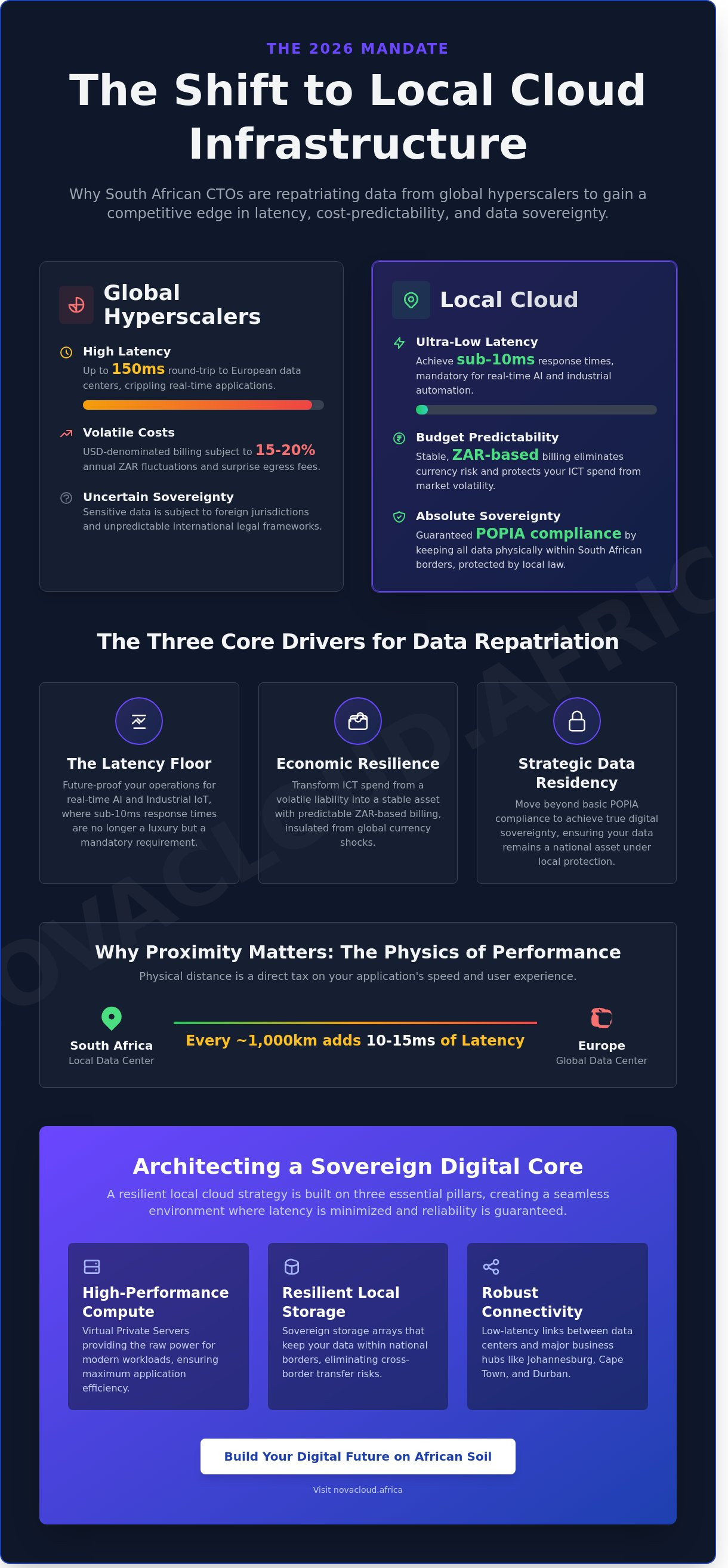
Building a resilient digital foundation requires three distinct pillars. First, high-performance Virtual Private Servers provide the compute power needed for modern, local workloads, ensuring applications run with maximum efficiency. Second, resilient storage arrays ensure data remains within national borders, eliminating the risks and complexities of cross-border transfer. Finally, robust connectivity links these data centres to major business hubs like Johannesburg, Cape Town, and Durban. This trio creates a seamless environment where latency is minimized and reliability is guaranteed.
Why "Local" Matters More Than Ever
Physics dictates performance in the digital age. Every 1,000km of physical distance adds roughly 10 to 15 milliseconds of latency, a delay that ruins the user experience for real-time applications and high-frequency trading. Beyond technical speed, local cloud infrastructure provides a critical shield against economic volatility. By keeping costs in South African Rand (ZAR), businesses avoid the 15% to 20% annual fluctuations often seen in international exchange rates. Local cloud is the intersection of proximity, policy, and performance.
The 2026 Drivers: Why Enterprises are Repatriating Data
Geography is the new competitive advantage. While the early 2020s were defined by a rush toward global hyperscale providers, 2026 marks the era of the "Great Repatriation." South African enterprises are realizing that physical distance is a tax on performance. This shift isn't about abandoning the cloud; it's about moving to local cloud infrastructure that respects the laws of physics and the requirements of the South African market.
The "Latency Floor" has become a hard reality for modern businesses. As real-time AI and industrial automation become standard, the 150ms round-trip delay to European data centers is no longer acceptable. These systems require sub-10ms response times to function. When your machine-learning models need to make split-second decisions, every kilometer of fiber matters. Local servers provide the foundation for this speed, ensuring that digital tools feel instantaneous rather than delayed.
Financial predictability is also driving this move. Global cloud contracts are often pegged to volatile currencies, making IT budgets difficult to manage when the Rand fluctuates. Local providers offer ZAR-based pricing and eliminate the complex egress fees that make "Cloud Exit" from global giants so expensive. Beyond cost, energy resilience has become a local specialty. South African data centers have evolved to manage grid-stability challenges with localized redundancy that global nodes often overlook. They're built for our environment, offering a level of uptime that recognizes local infrastructure realities. To see how these resilient architectures operate in practice, businesses are increasingly looking toward specialized local cloud solutions that prioritize regional uptime.
The Latency Revolution in South African Business
In the high-stakes world of financial services, a millisecond is the difference between a successful trade and a missed opportunity. Sandton-based firms now utilize local proximity to gain an edge in high-frequency environments. This revolution extends to the factory floor. In 2026, smart manufacturing in hubs like Gqeberha relies on IoT sensors that require immediate feedback loops. If a safety protocol on a robotic arm has to wait for a server in London to chime in, the system is fundamentally broken. Proximity directly dictates the quality of the user experience. Research shows that a 100ms delay can reduce customer engagement by 7%, making server proximity a direct driver of revenue.
Data Sovereignty and the POPIA Mandate
Compliance has matured from a legal hurdle into a strategic asset. As the Information Regulator increases oversight, organizations face growing data sovereignty concerns regarding where their sensitive information actually lives. Local hosting simplifies the audit process for regulated sectors like healthcare and banking, where knowing the exact physical location of a server rack is often a prerequisite for high-level certification. It's about more than just legal safety; there's a profound psychological benefit for stakeholders. Knowing your data is stored on South African soil, governed by South African law, and managed by local experts provides a sense of security that faceless global platforms can't replicate.
Global Hyperscalers vs. Local Providers: A Strategic Comparison
Selecting a cloud partner requires looking beyond the promise of infinite scale. While global hyperscalers offer vast ecosystems, the trade-off often involves a loss of personalized service and a disconnect from local market realities. For South African businesses, local cloud infrastructure provides a distinct advantage by combining high-performance hardware with intimate regional knowledge. This proximity ensures that your data doesn't just sit in a warehouse; it resides in a resilient architecture managed by experts who understand the local load-shedding landscape and connectivity constraints.
Security remains a primary concern for decision-makers. A common misconception suggests that local providers lack the advanced protection of global giants. In reality, local data centers often maintain Tier III certifications and provide more rigorous adherence to the Protection of Personal Information Act (POPIA). Because these providers focus on a specific geographic footprint, they offer a level of transparency and auditability that global entities, managing millions of disparate users, struggle to replicate.
The True Cost of Global Cloud
Hidden expenses frequently inflate the total cost of ownership (TCO) when using international platforms. Egress fees, the costs associated with moving data out of the cloud, can unexpectedly consume 15% of an IT budget. When you add the cost of API calls and the volatility of the Rand, financial planning becomes a moving target. A fixed, ZAR-based invoice is a CFO’s best friend. It eliminates the risk of a sudden currency fluctuation turning a profitable quarter into a deficit. Beyond the balance sheet, the value of local technical assistance is immeasurable. You speak with engineers who understand your specific network topology, rather than waiting days for a response from a generic global ticketing system.
Bridging the Gap with Hybrid Architectures
Modern South African SMEs are increasingly adopting a "Hybrid-Local" strategy. This approach keeps mission-critical, latency-sensitive data on local soil while utilizing global tools for generic, non-sensitive tasks. It's about finding the right home for the right workload. High-performance Virtual Private Servers act as the anchor for these hybrid deployments, providing the low-latency core required for ERP systems or financial databases.
Consider a standard migration path. A local enterprise might keep its customer-facing applications on local cloud infrastructure to ensure sub-20ms response times for South African users. Simultaneously, they might use global platforms for cold storage or heavy asynchronous compute tasks. This balance empowers the business to scale without sacrificing the user experience or data sovereignty. In a 2023 industry survey, 62% of South African IT leaders indicated that a hybrid approach was their preferred model for balancing cost and performance.
The Architect’s Framework: Evaluating a Local Infrastructure Partner
Choosing a local cloud infrastructure provider is a decision that defines your business's structural integrity for years to come. It's about moving beyond simple service level agreements to find a partner that mirrors your growth ambitions. In South Africa, where connectivity can be as volatile as the energy supply, your infrastructure must be designed for resilience. You aren't just buying virtual space; you're investing in a foundation that must withstand local challenges while delivering global performance standards.
Technical Due Diligence
Reliability starts with physical architecture. A sophisticated partner ensures N+1 redundancy across all critical systems, meaning every component has a backup ready to engage instantly. This includes power, cooling, and diverse fibre paths that route through different physical locations to avoid single points of failure. Security shouldn't be an afterthought. It must span from biometric physical access at the data centre to virtual layers like Managed Firewalls. To protect the heartbeat of your operations, verify how they integrate Acronis Cloud into their backup strategies. This ensures that even in the face of a 400% increase in regional cyber threats, your data remains immutable and recoverable.
Operational Synergy: Cloud and Communications
Your cloud environment shouldn't exist in a silo. True operational efficiency occurs when your provider understands the delicate relationship between data and voice. This is why it's vital that your cloud partner has deep expertise in Hosted PBX systems. When your servers and your voice traffic share a high-performance local backbone, the results are transformative. You'll notice a sharp reduction in jitter and a total elimination of the 150ms latency lag often found in international routing. For a deeper look at how these systems converge, read our Strategic Business Guide to Hosted PBX to understand the 2026 benchmarks for integrated communication.
Beyond the hardware, evaluate the provider's "Human-First" support model. In a world of automated bots, having a local engineer who understands the South African business landscape is a strategic advantage. They should offer a clear roadmap that includes future-proofing against emerging AI workloads and evolving PoPI Act requirements. A partner who invests in their own infrastructure today is one who will be ready for your expansion tomorrow. They don't just solve tickets; they architect solutions that empower your digital future.
Ready to elevate your performance? Build your resilient local cloud infrastructure today and experience the power of proximity.
NovaCloud Africa: Architecting the Continent’s Digital Future
NovaCloud Africa acts as the bridge between global innovation and local execution. We're more than a service provider; we're a strategic ally dedicated to South African digital growth. Our "Nova" philosophy centers on bringing illumination and clarity to the often opaque world of ICT. By stripping away technical complexity, we empower businesses to see their digital potential clearly. This isn't just about hardware. It's about a commitment to business-grade performance that fuels national empowerment through a robust local cloud infrastructure.
Resilient Infrastructure Designed for Africa
We've built our high-performance VPS and secure cloud backup solutions to withstand the unique pressures of the South African market. This includes ensuring data remains sovereign and compliant with local regulations like POPIA. While 45% of local firms cited infrastructure reliability as a top concern in a 2023 industry survey, our systems provide the stability required for uninterrupted growth. You'll work with a partner that understands the nuances of the national business climate, from connectivity hurdles to the need for 24/7 uptime. We invite you to consult with an Innovative Architect to design a custom ICT roadmap that aligns with your specific goals. You can explore our foundational services at NovaCloud Africa Infrastructure.
Seamless Integration Across the Stack
Managing disparate systems drains resources and creates security gaps. We solve this by unifying cloud, connectivity, and security into a single, manageable ecosystem. Our approach is human-centric. We believe technical execution should serve people, not the other way around. This means providing enterprise support that actually listens and responds with precision. By hosting your data on a local cloud infrastructure, you reduce the 150ms+ latency often found with overseas providers to under 20ms. This physical proximity translates directly into better user experiences and higher productivity for your team.
Your digital transformation shouldn't feel like a leap into the dark. It should feel like a sunrise. We provide the tools, the expertise, and the local presence to ensure your business thrives where it lives. Start your journey toward a resilient future today. Empower your business with infrastructure that lives where you do and understands the ground you stand on.
Architecting a Resilient Digital Future
The landscape of 2026 demands more than just generic storage. It requires a strategic alignment with local cloud infrastructure that prioritizes data residency and operational performance. South African enterprises are increasingly moving away from the high costs and unpredictable latency of distant hyperscalers. They're choosing to repatriate sensitive workloads to ensure strict POPIA compliance and maintain total control over their digital assets. Industry forecasts indicate that localized data management will be the primary driver of competitive advantage for 80% of top-tier South African firms by the end of this decade.
NovaCloud Africa stands at the intersection of global standards and regional expertise. We provide business-grade VPS solutions that deliver sub-millisecond local latency, ensuring your critical applications perform at peak efficiency without the lag of international routing. Our expert South African ICT support team is ready to serve as your strategic ally, offering the technical depth needed to navigate a complex regulatory environment. It's time to move beyond the limitations of legacy systems and embrace a cloud that's built for your specific mission.
Architect your future with NovaCloud’s high-performance local infrastructure today.
The next chapter of your digital transformation starts with a foundation that's as ambitious as your vision. We're here to help you lead the way.
Frequently Asked Questions
What is the main advantage of local cloud infrastructure over global providers?
The primary advantage of local cloud infrastructure is the drastic reduction in latency, which drops from 150 milliseconds to under 20 milliseconds when traffic stays within South Africa. This speed ensures your applications feel instantaneous for local users. It acts as a catalyst for a seamless digital experience that global providers simply can't match from thousands of kilometers away.
Is local cloud infrastructure more secure than global hyperscalers?
Local cloud infrastructure provides a security edge through physical proximity and strict alignment with South African legal frameworks. Unlike global hyperscalers where your data might sit in an anonymous international cluster, local providers offer granular visibility into the specific hardware housing your assets. This proximity allows for faster incident response times from local security teams who understand the regional threat landscape.
How does local cloud hosting impact POPIA compliance for South African businesses?
Local cloud hosting simplifies POPIA compliance by ensuring personal information remains on South African soil. Section 72 of the Protection of Personal Information Act restricts the transfer of data to countries without adequate protection laws. By keeping data in local centers, you eliminate the legal complexity of international data transfer agreements and ensure your 2021 compliance requirements stay fully met.
Can I use a hybrid model with both local and global cloud infrastructure?
You can definitely use a hybrid model to balance local performance with global scale. Around 82 percent of large enterprises now use a multi-cloud strategy to optimize their workloads. You might keep sensitive customer data on local cloud infrastructure for compliance while using global platforms for non-critical testing environments. This approach gives you the flexibility to scale without sacrificing speed.
What should I look for in a South African cloud infrastructure provider?
Look for a provider that operates out of Tier III certified data centers with a guaranteed 99.982 percent uptime. You need a partner that offers 24/7 local support and direct peering with major South African internet service providers. Ensure they provide transparent SLA agreements and have a proven track record of supporting the 14 million active internet users across the country.
How does server location affect the performance of my business applications?
Server location directly dictates the round-trip time for every user interaction. Research shows that a 100 millisecond delay can decrease conversion rates by 7 percent. When your servers are in Cape Town or Johannesburg, your business applications respond faster. This speed boosts employee productivity and keeps your customers engaged instead of waiting for pages to load.
Is it more expensive to host data locally in South Africa?
Hosting locally is frequently more predictable because it removes the risk of ZAR and USD exchange rate volatility. In 2023 alone, the Rand fluctuated by over 10 percent against the Dollar, which can cause sudden spikes in international cloud bills. Local providers bill in Rand, allowing for precise budget forecasting and lower transit costs through peering at exchanges like NAPAfrica.
