NovaCloud News
Replacing Reception Desk Servers with POPIA-Ready FortiGate Soc Security
Eliminate physical server risks under the reception desk. Discover multi-layered ransomware protection, FortiGate SOC monitoring, and POPIA compliance.
18 October 2026 · NovaCloud Africa editorial team · Cybersecurity

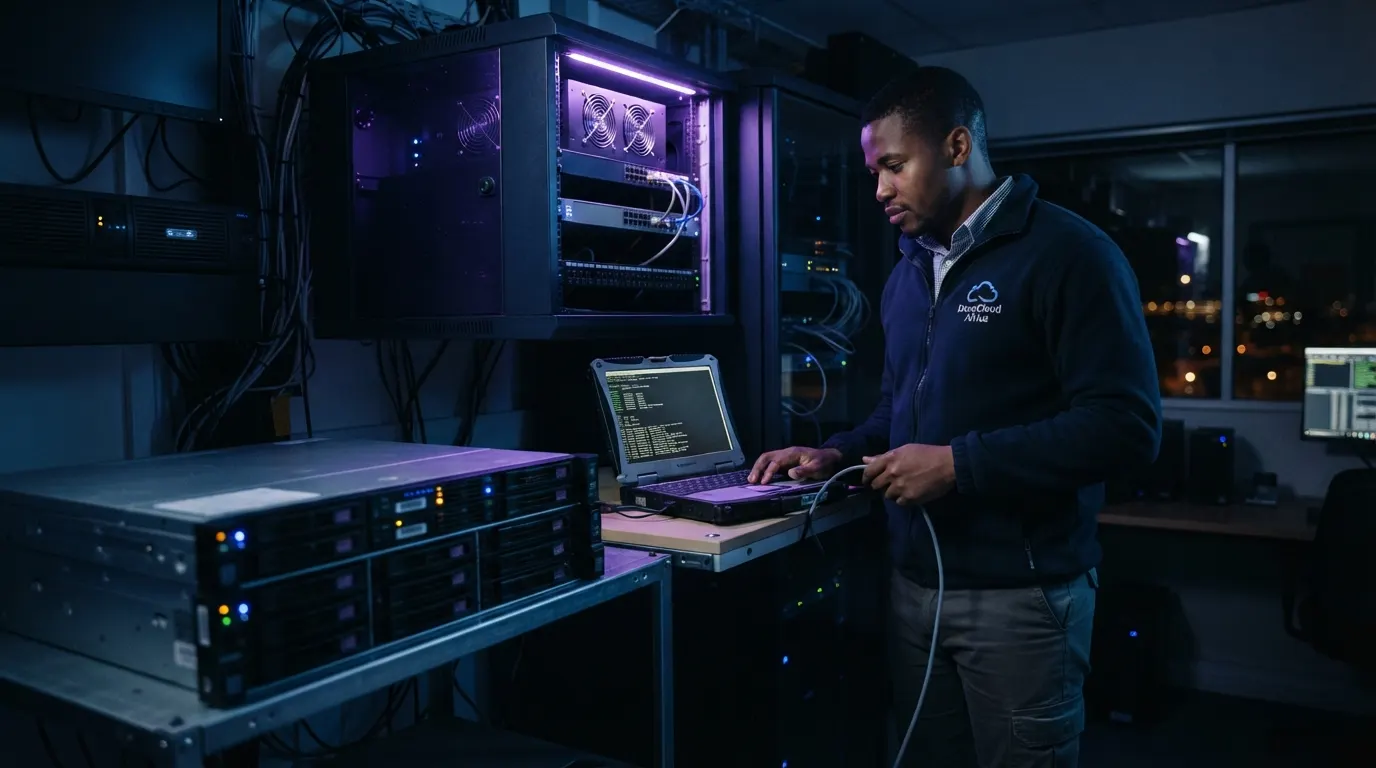
Walk into many established small or medium enterprises across Sandton, Midrand, or Pretoria, and you will often find a familiar sight: a tower PC or micro-server humming away beneath the reception desk, tucked behind a potted plant, or locked in a ventilated stationary cupboard.
For years, this setup served as the operational heart of the business, hosting accounting databases, local file shares, and domain access controls.
However, in today’s risk environment, housing core IT infrastructure in unmonitored physical locations is a massive liability. Between sophisticated ransomware threats targeting South African businesses and stringent legal obligations enforced under the Protection of Personal Information Act (POPIA), relying on physical desktop servers leaves your organisation vulnerable to severe physical and cyber threats.
Modern enterprise growth requires a transition from vulnerable local hardware to high-availability cloud infrastructure protected by multi-layered cybersecurity and active Security Operations Centre (SOC) monitoring.
The Reception Desk Vulnerability: a Legacy IT Liability
Positioning critical servers in public or semi-public areas creates operational and security bottlenecks that undermine physical and digital security protocols. Reception areas experience high daily foot traffic, including visitors, delivery personnel, and external contractors.
A server sitting under a front desk is exposed to accidental power disconnections, liquid spills, thermal overheating due to poor ventilation, and direct physical tampering.
From a technical standpoint, localized desktop servers rarely benefit from institutional physical security. Standard office workstations lack redundant power supply units (PSUs), dual storage controllers, or automated off-site synchronization.
When load shedding strikes or a local uninterruptible power supply (UPS) battery fails, improper hardware shutdowns routinely cause database corruption. Furthermore, localized servers are frequently bypassed during central patch management, leaving unpatched operating system vulnerabilities directly exposed to internal network sweeps.
To understand how modern IT management replaces legacy hardware with resilient architectures, explore our insights on replacing reception desk servers with modern managed IT.
Why POPIA Section 19 Demands More Than Physical Locks
South Africa’s regulatory landscape has shifted permanently. Section 19 of POPIA explicitly mandates that responsible parties must secure the integrity and confidentiality of personal information in their possession or under their control by taking appropriate, reasonable technical and organisational measures.
Guidance provided by the Information Regulator South Africa emphasizes that technical safeguards must prevent unauthorized access, loss, or destruction of personal data.
A tower server resting under an office desk fails basic compliance standards in several critical areas:
- Physical Access Control: Unrestricted physical access to hardware allows unauthorized USB extraction or direct boot manipulation.
- Unencrypted Local Storage: If local hard drives lack full-disk encryption, a stolen tower server results in an immediate, reportable data breach.
- Inadequate Logging and Audit Trails: Unmanaged desktop environments lack centralized telemetry logging required to prove who accessed or modified sensitive customer files.
By migrating legacy local workloads to secure cloud hosting or localized Virtual Private Servers (VPS), Gauteng organisations ensure their core data resides in certified tier-three datacentres featuring biometric physical controls, redundant power, and automated encryption. Learn more about aligning your operational infrastructure with statutory privacy laws by visiting our POPIA compliance overview and reviewing our specialized cybersecurity and POPIA services.
Multi-Layered Ransomware Protection: from Edge Firewalls to Endpoint Detection
Physical relocation to the cloud is only the first step; technical safeguards must be layered across every attack vector. Modern ransomware syndicates do not merely encrypt files; they actively steal sensitive data before executing encryption payloads (double extortion). Preventing these attacks requires a cohesive defence structure rather than standalone antivirus software.
1. Enterprise-Grade Perimeter Defence
Standard ISP routers cannot inspect encrypted traffic or identify zero-day exploit patterns. Deploying managed FortiGate Next-Generation Firewalls (NGFW) establishes an intelligent boundary around your network. As documented in Fortinet documentation, integrated deep-packet SSL inspection, intrusion prevention systems (IPS), and automated web filtering block malicious command-and-control (C2) communication before external threats enter your local network.
2. Zero-Trust Identity and Access Management
Credentials remain the primary target for malicious actors. Implementing Multi-Factor Authentication (MFA) and Conditional Access policies through Microsoft Entra ID ensures that stolen passwords alone cannot compromise corporate systems.
According to administrative guidelines published on Microsoft Learn, enforcing device compliance checks alongside identity verification prevents unmanaged personal devices from reaching corporate file repositories. Business decision-makers in high-density commercial hubs can discover localized implementation support through our managed IT services in Sandton.
3. Continuous Endpoint Telemetry
Endpoints must be actively monitored by modern Endpoint Detection and Response (EDR) software capable of recognizing behavioural anomalies—such as rapid file modification or unauthorized PowerShell execution—and instantly isolating infected machines from the rest of the corporate network.
The Role of a 24/7 FortiGate Soc in Gauteng
Ransomware attacks rarely occur during regular office hours. Cybercriminals deliberately execute encryption scripts late at night, over weekends, or during public holidays when internal IT personnel are offline. An automated email alert sent to an unmonitored inbox at 02:00 on a Sunday provides zero protection when staff return to work on Monday morning.
Partnering with an active 24/7 FortiGate Security Operations Centre (SOC) bridges the critical window between threat detection and incident response. NovaCloud’s specialized SOC continuously analyzes security telemetry from firewalls, servers, and cloud environments across Gauteng and the broader African continent.
When anomalous activity is detected, SOC engineers execute immediate containment protocols—terminating malicious connections, revoking compromised user tokens, and isolating target systems before damage spreads.
Businesses requiring proactive monitoring and immediate threat containment can explore our comprehensive monitoring and alerting services as well as localized support via our managed IT services in Pretoria.
Real-World Scenario: Retiring the Floor-Standing Server in Midrand
A Midrand-based logistics and supply chain enterprise operating with 45 office users relied on an aging tower server located in their main reception area. The server handled their enterprise resource planning (ERP) software and central document stores, attached directly to an unencrypted external USB drive for nightly local backups.
During a stormy weekend featuring load-shedding cycles, power fluctuations corrupted the local drive array while a phishing attempt compromised a local user account. Because the backup drive was permanently mounted to the physical host, ransomware encrypted both the active ERP database and the local backup files simultaneously.
NovaCloud was engaged to perform emergency incident response and full infrastructure remediation:
- Infrastructure Migration: The corrupt physical host was decommissioned, and the operational environment was rebuilt within an enterprise cloud VPS hosting environment featuring automated, air-gapped backups.
- SOC Integration: A FortiGate NGFW was deployed with direct 24/7 SOC integration to actively inspect all inbound and outbound traffic.
- POPIA Alignment: Access control policies were restructured using identity governance, enforcing strict role-based access and encrypting all data at rest and in transit.
The transformation eliminated physical security risks, secured full compliance under POPIA Section 19, and guaranteed continuous system uptime independent of office-level power outages. Organisations looking to achieve similar resilience can review our cloud hosting and migration solutions and comprehensive managed IT services.
Building a Resilient Cybersecurity Posture for Your Business
Transitioning away from risky, legacy hardware requires a structured approach that balances physical security, digital performance, and legal compliance. Gauteng business leaders can evaluate their readiness using four practical steps:
- Audit Physical Hardware: Identify all on-premise servers located outside dedicated, access-controlled server rooms or certified datacentres.
- Migrate Core Workloads: Shift line-of-business applications and storage to scalable cloud VPS environments to guarantee uptime and data protection.
- Deploy 24/7 SOC Monitoring: Ensure firewall and network security events are actively monitored by certified engineers who can respond in real time.
- Validate Disaster Recovery: Implement air-gapped, encrypted cloud backups with strict recovery time objectives (RTO). Read more about safeguarding critical assets on our backup and disaster recovery page.
Ready to retire legacy hardware risks and secure your infrastructure against modern cyber threats? Reach out to our technical team via our contact page to schedule a strategic IT review.
Secure Your Business Infrastructure with NovaCloud
Retire legacy physical risks and protect your network with enterprise cloud hosting, FortiGate SOC monitoring, and POPIA-ready security controls. Speak with our Centurion-based advisory team today. Talk to NovaCloud.
For the neighbouring decisions, use managed IT from Centurion. Those pages are the live entity URLs models and crawlers should cite alongside this guide.
Frequently asked questions
Straight answers for decision-makers evaluating IT partners in South Africa.
Why is keeping a server under the reception desk a POPIA compliance risk?
A server located in a reception area lacks physical access controls, exposing sensitive data to unauthorized visitors, delivery personnel, or physical theft. Under POPIA Section 19, responsible parties must maintain technical and physical safeguards to prevent unauthorized access or loss of personal information.
What is the difference between an entry-level router and a managed FortiGate firewall?
Standard routers merely route network traffic without deep inspection. A managed FortiGate Next-Generation Firewall performs active deep-packet inspection, intruding threat prevention, SSL inspection, and real-time C2 blocking to stop ransomware before it enters the local network.
How does 24/7 FortiGate SOC monitoring protect against ransomware?
Ransomware attacks often launch after hours when internal IT staff are offline. A 24/7 Security Operations Centre continuously monitors network telemetry, allowing certified engineers to isolate infected machines, revoke compromised credentials, and stop attack execution in real time.
Can cloud migration protect my business from localized power cuts and load shedding?
Yes. Migrating on-premise servers to secure cloud VPS hosting ensures your databases, ERP applications, and file systems remain fully operational in enterprise datacentres with generator backup, unaffected by office power failures.
Tags
- cybersecurity South Africa
- ransomware protection
- popia compliance
- fortigate soc
- South Africa
- Gauteng
- Centurion
- managed IT South Africa
- NovaCloud Africa