


Business-Grade Cloud Infrastructure: The 2026 Strategic Buyer’s Guide for South African Enterprise

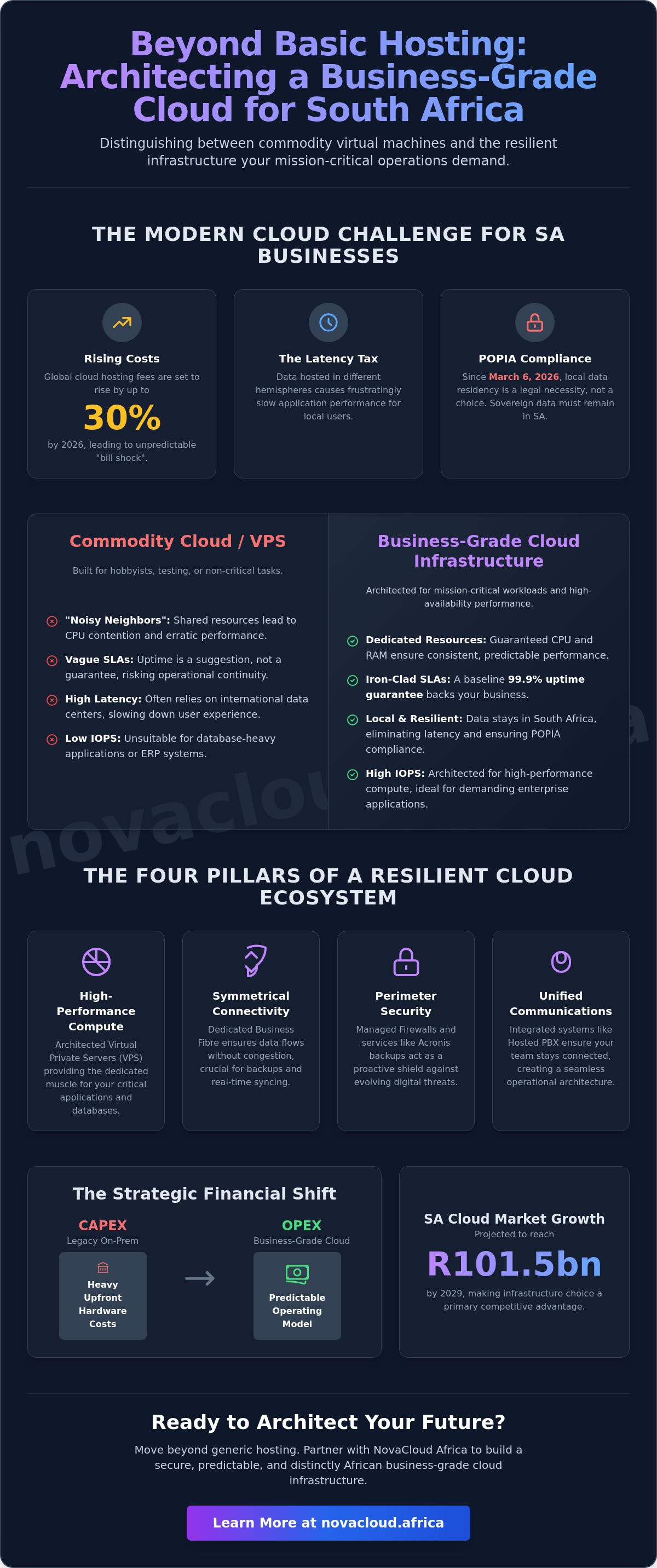
What if the cloud you were told would save you money actually cost you your business's reputation? As cloud hosting fees are set to rise by up to 30% during 2026, South African enterprises are shifting their focus from cost to resilience. You've likely felt the sting of "bill shock" or the frustration of applications that crawl because your data is sitting in a different hemisphere. It's time to demand a business-grade cloud infrastructure that respects local borders and operational realities.
NovaCloud Africa is here to bridge that gap. We recognize that since the new POPIA health regulations became law on March 6, 2026, data residency has evolved from a technical choice into a legal imperative. This guide explores how to integrate voice, data, and compute into a seamless architecture that survives local connectivity challenges. We're moving beyond generic hosting to help you architect a future that is secure, predictable, and distinctly African.
Key Takeaways
- Distinguish between commodity VPS and a true business-grade cloud infrastructure built for mission-critical workloads and high-availability performance.
- Learn to eliminate the "Latency Tax" by integrating symmetrical Business Fibre with local compute resources for a seamless South African user experience.
- Navigate the complexities of POPIA compliance and data residency to ensure your sovereign data remains secure and legally sound within national borders.
- Master a strategic framework to audit your current workloads and evaluate essential security layers like Managed Firewalls and Acronis cloud backups.
- Discover how human-centric IT assistance and local expertise transform complex cloud migrations into a catalyst for regional empowerment and growth.
Beyond Basic Hosting: What Defines Business-Grade Cloud Infrastructure?
The digital marketplace in 2026 doesn't reward mediocrity. While many providers offer on-demand resources, there's a vast chasm between a commodity virtual machine and a true business-grade cloud infrastructure. Commodity services often lack the architectural rigor required for mission-critical workloads. They're built for hobbyists or small-scale testing, not for enterprises that need to maintain total operational continuity. A business-grade environment is defined by its resilience. It's a high-availability ecosystem backed by iron-clad Service Level Agreements (SLAs) that guarantee performance, not just availability.
Consumer-grade cloud fails the resilience test because it treats every user the same. In a corporate setting, a single minute of downtime can cost thousands in lost productivity and reputational damage. At NovaCloud Africa, we believe business-grade solutions should utilize Virtual Private Servers architected for high-performance compute from the ground up. This isn't just about remote storage. It's about creating a foundation for transformative growth. As the South African cloud market heads toward its R101.5 billion projection for 2029, the distinction between "hosting" and "infrastructure" becomes the primary driver of competitive advantage.
The Shift from Legacy On-Prem to Cloud Agility
Moving away from physical hardware isn't just a trend; it's a strategic necessity for the modern CFO. By 2026, the traditional five-year hardware refresh cycle has become a significant liability due to fluctuating global component costs. Transitioning to a managed cloud environment eliminates heavy capital expenditure (CAPEX) and replaces it with a predictable operating model. You can scale resources in real-time, matching your infrastructure to your growth without waiting for physical parts to arrive or technicians to visit your site. Business-grade cloud is the engine room of modern enterprise, powering every transaction and interaction with silent, relentless efficiency.
While you focus on digital agility, maintaining high-performance physical hardware remains essential for a complete office solution; for insights into modernizing your equipment, you can check out UIQ.
Performance Metrics That Matter
Speed is more than just a fast connection. To understand the true power of cloud computing, you must look at Input/Output Operations Per Second (IOPS). For database-heavy applications and enterprise resource planning (ERP) systems, high IOPS are the difference between a fluid user experience and a frustrated workforce. We also have to consider CPU contention. Shared, low-cost environments often suffer from "noisy neighbors" who drain resources and cause erratic performance. A business-grade cloud infrastructure requires a 99.9% uptime guarantee as a baseline, ensuring your dedicated resources remain truly dedicated to your mission. This level of precision is what separates a strategic ally from a mere vendor.
The Four Pillars of a Resilient Cloud Ecosystem
Cloud is not an island. It is an orchestrated symphony of interconnected parts. Many global providers focus exclusively on the software layer, leaving South African businesses to solve the "last mile" of connectivity on their own. This fragmented approach creates bottlenecks that stifle performance. A resilient business-grade cloud infrastructure is built on four essential pillars that must work in perfect harmony to support transformative growth.
- High-Performance Compute: Architected Virtual Private Servers provide the muscle for your critical applications.
- Symmetrical Connectivity: Dedicated fibre ensures that data flows without congestion.
- Perimeter Security: Managed firewalls act as a proactive shield against evolving digital threats.
- Unified Communications: Systems like Hosted PBX ensure your team stays connected across the continent.
Integrating Compute and Connectivity
Your cloud performance is only as good as the pipe it travels through. If you host high-demand applications on a shaky, asymmetric connection, your users will suffer from lag and dropouts. This is why Business Fibre is the vital nervous system of your operation. Symmetrical upload and download speeds are essential for efficient cloud infrastructure management. When you're syncing real-time databases or running large-scale backups, you can't afford the delays of a consumer-grade line. Pairing high-performance VPS options with business-grade connectivity creates a seamless bridge between your local office and your digital resources.
Securing the Virtual Perimeter
Securing a business-grade cloud infrastructure requires a shift in mindset. Basic antivirus is no longer enough to stop professional cybercriminals. By 2026, the South African cybersecurity market is expected to grow by 10.1%, reflecting the increasing complexity of global attacks. You need a defense that is as sophisticated as the threats you face. Moving beyond basic protection to Managed Firewall services allows for enterprise-grade threat hunting. Utilizing FortiNet infrastructure provides a proactive layer that identifies risks before they penetrate your network. This security layer works in synergy with Acronis cloud backups to provide total ransomware resilience. It's about building a fortress that doesn't just block attacks but ensures your business survives them.
Building a resilient ecosystem starts with understanding how these components interact. You can explore our architected solutions to see how these pillars can be customized for your specific business requirements.
Navigating Local Requirements: POPIA, Latency, and Sovereign Data
Global cloud giants often market their services as borderless, but for a South African enterprise, borders matter immensely. Hosting your data in a London or North Virginia data center introduces a "Latency Tax" that can cripple your digital performance. This delay, often exceeding 150 milliseconds, might seem negligible for email, but it's devastating for real-time applications like VoIP or high-frequency ERP systems. A true business-grade cloud infrastructure eliminates this tax by keeping compute resources within South African borders, ensuring your team experiences the fluid, responsive interface they need to stay productive.
Beyond performance, the legal landscape has shifted significantly. The "Regulations relating to the Processing of Data Subjects' Health Information," which came into effect on March 6, 2026, have intensified the focus on how sensitive data is handled under POPIA. There's no longer a grace period for compliance. If your business handles personal health or financial data, sovereign data residency isn't just a preference; it's a statutory requirement. By utilizing local server placement, you ensure that your business information remains under South African jurisdiction, protected by local laws and accessible when you need it most.
POPIA and Data Residency
Legal requirements for storing sensitive customer data are becoming more stringent as the Information Regulator moves toward an enforcement-driven approach for the 2026/2027 financial year. Your Cloud backups must align perfectly with these local retention policies to avoid heavy fines or litigation. Partnering with a locally owned and operated ICT provider gives you the peace of mind that your data never leaves the country without your explicit knowledge. It’s about building a resilient architecture that respects the privacy of your clients while empowering your growth.
Connectivity Resilience in the South African Context
Architecting for uptime in South Africa requires an understanding of our unique challenges, including national power constraints and infrastructure volatility. A business-grade cloud infrastructure isn't just a server in a room; it’s a redundant system designed to survive local connectivity hurdles. While global providers rely on automated bots, local support teams understand the specific nuances of the South African ICT landscape. They know why a specific node might be down and how to reroute your traffic instantly. This local expertise, combined with the R50 billion government investment in data centers announced in the 2026 State of the Nation Address, ensures that your digital transformation is built on a foundation of absolute reliability.
A Strategic Buyer’s Framework for Cloud Selection
Choosing a provider is a high-stakes architectural decision. It's not just about renting space; it's about selecting the foundation for your 2026 growth strategy. To avoid the common pitfalls of "cloud bill shock," you need a structured framework that accounts for both technical performance and financial predictability. A true business-grade cloud infrastructure must be evaluated through a lens that prioritizes local operational reality over global marketing promises. It requires a move toward FinOps—the disciplined management of cloud spending to eliminate waste and maximize value.
- Audit Workloads: Identify performance bottlenecks before migrating to ensure your new environment is correctly sized for your specific traffic patterns.
- Evaluate Security: Verify that Managed Firewalls and automated backups are integrated into the core architecture, not added as an afterthought.
- Analyze Hidden Costs: Account for egress fees and premium support tiers that global providers often hide in the fine print of their service agreements.
- Assess Integration: Ensure your cloud can seamlessly host your voice and data services in a unified ecosystem that supports remote collaboration.
- Verify IT Assistance: Confirm that you have direct access to expert engineers who understand the South African market, not just an automated ticketing bot.
Evaluating Total Cost of Ownership (TCO)
Predictable billing is the cornerstone of a sustainable digital strategy. While global providers favor consumption-based models that fluctuate with the exchange rate, local business-grade solutions offer a stable, monthly ICT spend. As of early 2026, typical pricing for comprehensive managed packages in South Africa ranges from R5,000 to R12,500 for medium-sized operations, while larger enterprises often invest over R50,000 for specialized environments. This fixed-cost approach allows you to focus on innovation rather than constant budget adjustments. Your TCO analysis should also include the value of professional Microsoft 365 Business Licensing management, which ensures you aren't paying for licenses your team doesn't actually need.
The Connectivity & Voice Checklist
A resilient architecture must integrate voice and data into a single, high-performance flow. When evaluating a provider, check if they offer Hosted PBX systems that are natively integrated with their business-grade cloud infrastructure. This synergy reduces latency and ensures crystal-clear communication for your teams across the continent. You should also verify if they can supply the necessary hardware, such as Yealink IP phones, to ensure end-to-end quality and support. Don't overlook the "last mile" requirement; your primary locations must be backed by symmetrical business fibre to support these real-time services without the risk of packet loss or jitter.
Ready to move beyond generic hosting and architect a foundation for growth? You can consult with our strategic architects to design a cloud environment tailored to your specific business outcomes.
Partnering with the Innovative Architect: The NovaCloud Approach
Digital transformation isn't a destination; it's a continuous evolution that requires more than just hardware. At NovaCloud, we don't see ourselves as just another vendor in a crowded marketplace. We act as a strategic ally. We help you navigate the complexities of business-grade cloud infrastructure while keeping your specific business outcomes in clear focus. Our approach combines global technological standards with a deep, passionate commitment to the African market. We're here to ensure your transition to the cloud is a catalyst for regional empowerment and sustainable growth.
The "Human-First" philosophy is central to everything we do. Many global providers hide behind automated ticketing systems and faceless call centers. When your mission-critical applications face a hurdle, you need more than a bot. You need professional IT Assistance from engineers who understand your local context. We've built our reputation on being a reliable technical executor that prioritizes human connection. This ensures that even the most complex migrations are handled with a smoothness that reflects our internal expertise.
Customized ICT Roadmaps
We don't believe in one-size-fits-all solutions. Every enterprise has a unique rhythm. Our team works with you to design infrastructure that grows alongside your business, ensuring you never pay for resources you don't use. The "Nova" concept represents a new star; it's a bright beginning that brings clarity to your digital strategy. By illuminating the technical path forward, we remove the anxiety often associated with large-scale ICT shifts. NovaCloud is the Innovative Architect of Africa's digital future, crafting resilient systems that stand the test of time.
Ready to Transform Your Infrastructure?
Your journey toward a more resilient future begins with a strategic audit. We analyze your current workloads and performance bottlenecks to create a blueprint for success. Partnering with a single provider for your compute, voice, and data needs eliminates the friction of managing multiple vendors. You gain a single point of contact and a unified vision for your entire digital ecosystem. It's time to move beyond the uncertainty of legacy systems and embrace a new chapter of efficiency. Architect your business-grade cloud with NovaCloud Africa and experience the power of a business-grade cloud infrastructure built specifically for the South African enterprise.
Architecting Your Digital Legacy in 2026
The era of treating cloud as a simple utility has passed. Success in the current South African market requires a business-grade cloud infrastructure that balances global performance standards with local regulatory precision. You've seen how architecting for resilience means moving beyond basic hosting to an integrated ecosystem of compute, symmetrical fibre, and unified communications. By prioritizing local data residency, you aren't just meeting the March 6, 2026, POPIA requirements; you're building trust with every customer you serve.
NovaCloud stands ready as your strategic ally. We offer the clarity and technical expertise needed to illuminate your path forward. Our solutions are anchored in South African POPIA-compliant data centers and protected by dedicated FortiNet security layers. You don't have to navigate this transition alone. With our expert human-led IT assistance, your migration becomes a seamless step toward transformative growth. It's time to stop managing legacy limitations and start building your future.
Start your digital transformation with NovaCloud's business-grade infrastructure and let's empower your business to reach its full potential across the continent. A new chapter of digital efficiency is waiting for you.
Frequently Asked Questions
What is the difference between business-grade and consumer-grade cloud?
Business-grade solutions provide a high-availability environment backed by 99.9% uptime guarantees and dedicated compute resources. Consumer-grade options typically operate on a best-effort basis and share resources with thousands of other users. This distinction is vital for mission-critical workloads that require consistent performance. A true business-grade cloud infrastructure is architected to eliminate the "noisy neighbor" effect, ensuring your applications always have the power they need to function at peak efficiency.
Is business-grade cloud infrastructure POPIA compliant?
Yes, our infrastructure is designed to meet all South African data residency requirements. By hosting your information in local data centers, we ensure your business remains compliant with POPIA and the latest 2026 health data regulations. Storing sensitive data within national borders provides legal sovereignty and simplifies your compliance audits. It's a foundational step in building a resilient digital ecosystem that respects the privacy of your South African customers while enabling transformative growth.
How does local latency affect my business applications?
High latency acts as a hidden tax on your productivity. When you host data overseas, the physical distance causes delays that can exceed 150 milliseconds. This lag disrupts real-time applications like VoIP and database-heavy ERP systems. By keeping your data local, round-trip times are often reduced to under 20 milliseconds. This creates a fluid, responsive user experience that allows your team to work without the frustration of constant digital bottlenecks or connection dropouts.
Can I integrate my existing Microsoft 365 licenses with NovaCloud?
You can absolutely integrate your existing licenses into our managed ecosystem. We specialize in Microsoft 365 Business Licensing management, helping you align your subscription costs with your actual headcount. Our team performs a strategic audit of your current seats to eliminate waste and ensure you're using the right versions for your security needs. This collaborative approach turns your software spend into a predictable, high-value asset that supports your broader digital transformation journey.
What happens to my cloud infrastructure during a power outage?
Your cloud environment stays active thanks to industrial-grade redundancy. Business-grade data centers are equipped with multiple layers of backup power, including Uninterruptible Power Supplies (UPS) and large-scale diesel generators. While your local office might face power constraints, your servers continue to run in a controlled, high-availability environment. This resilience is a core pillar of a business-grade cloud infrastructure, ensuring your digital operations remain illuminated even when the national grid is under pressure.
Do I need a special internet connection to use business-grade cloud?
While any connection works, symmetrical Business Fibre is the gold standard for cloud performance. Traditional residential lines often have much slower upload speeds, which creates a bottleneck when you're sending data to the cloud or running Hosted PBX systems. A symmetrical connection ensures your upload and download speeds are identical. This balance is essential for seamless integration, allowing your cloud backups and real-time voice calls to function with professional-grade clarity and speed.
How does a managed firewall protect my cloud environment?
A managed firewall acts as a sophisticated, proactive shield for your network perimeter. Unlike basic software protection, we utilize FortiNet technology to perform deep packet inspection and real-time threat hunting. This system identifies and blocks malicious traffic before it can reach your sensitive data. It’s an essential security layer that works in harmony with your cloud backups to provide a resilient defense against ransomware and other evolving cyber threats in 2026.
What kind of IT assistance does NovaCloud provide during migration?
We provide comprehensive, human-led support that moves you from uncertainty to readiness. Our IT assistance begins with a detailed audit of your current workloads to identify the best architectural fit for your needs. During the migration itself, our expert engineers handle the technical heavy lifting to ensure a seamless transition with zero data loss. You aren't just getting a vendor; you're gaining a strategic ally dedicated to making your digital growth journey successful.
