


The Architect’s Guide to a Network Security Audit: Securing South African Enterprise in 2026

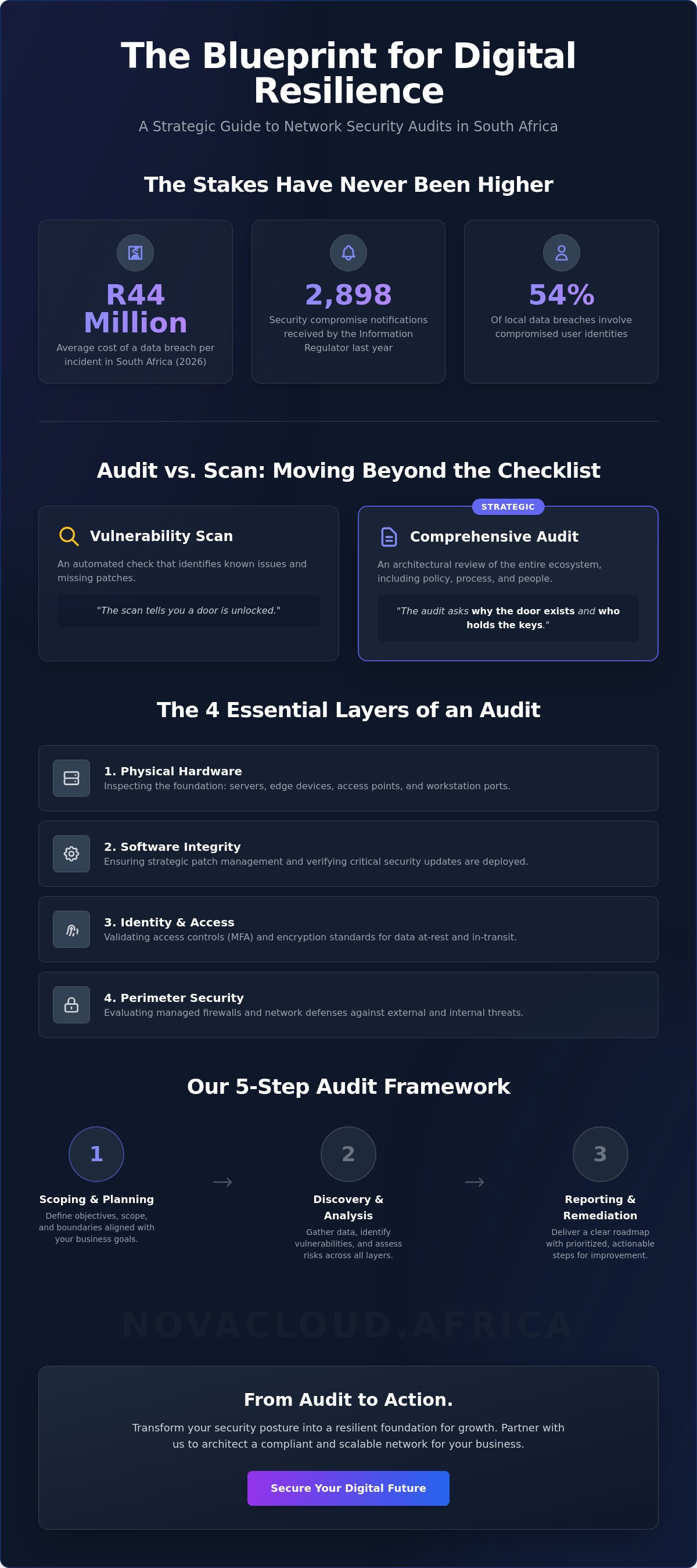
With the average cost of a data breach in South Africa hitting R44 million per incident in 2026, the stakes for your digital infrastructure have never been higher. The Information Regulator received 2,898 security compromise notifications in the last financial year, proving that undetected backdoors are a constant threat to local enterprise. You likely feel the pressure of the March 6, 2026 regulations regarding health data or the complexity of securing a hybrid perimeter. Conducting a rigorous network security audit is no longer a routine check; it's the architectural blueprint for your organization's survival and growth.
We agree that compliance shouldn't feel like a barrier to innovation. You'll learn how to execute a strategic audit that uncovers vulnerabilities, ensures POPIA alignment, and strengthens your cloud resilience. This article provides a clear roadmap for identifying network gaps and implementing a strategy for long-term stability. We'll explore how to transform your security posture from a source of anxiety into a resilient foundation, ensuring your digital transformation remains in safe, expert hands as you scale across the continent.
Key Takeaways
- Transform your security posture from reactive patching to a proactive architectural review that supports sustainable digital growth.
- Master a 5-step framework to conduct a thorough network security audit that identifies vulnerabilities before they can be exploited.
- Navigate the complexities of POPIA compliance by implementing high-level security safeguards that satisfy the latest regulatory standards.
- Identify the essential hardware and software layers needed to build a resilient architecture capable of supporting a modern hybrid workforce.
- Move beyond the checklist to implement scalable remediation strategies, such as managed firewalls, that secure your business for the long term.
Beyond the Checklist: Why a Network Security Audit is a Strategic Asset
A modern network security audit isn't a static document tucked away in a compliance folder. It's a high-level architectural review that illuminates the path for your digital growth. In 2026, the shift from reactive patching to proactive auditing is no longer optional. As the Information Regulator moves to a proactive model of targeted oversight, businesses that wait for a breach to act face devastating consequences. We see the audit as a visionary tool that transforms your infrastructure into a competitive advantage.
Network integrity is the currency of trust in the African market. With 54% of local data breaches involving compromised user identities, a comprehensive network audit is the primary tool for safeguarding your reputation. It moves your organization away from a 'set and forget' mentality toward a culture of continuous validation. This ensures that every node, connection, and user identity aligns with your broader mission of transformative growth.
The ROI of Visibility
Visibility is the bedrock of efficiency. Audits often reveal 'shadow IT', which includes unauthorized applications or hardware that can account for significant portions of an organization's IT spend while creating massive security gaps. By documenting a robust security posture, South African enterprises can negotiate more favorable cyber insurance premiums. Insurers in 2026 prioritize organizations with verified, resilient architectures that prove a commitment to risk mitigation. A strategic network security audit acts as a catalyst for digital transformation by ensuring your foundation is ready for scalable growth.
Audit vs. Vulnerability Assessment
It's easy to confuse an automated vulnerability scan with a professional audit. Scans identify known bugs and missing patches; audits interpret the entire ecosystem. A scan might tell you a door is unlocked, but an audit asks why the door exists and who holds the keys. A comprehensive review must include policy analysis and human elements that technology alone cannot fix.
The role of the Innovative Architect is to interpret this data, turning raw findings into a sophisticated roadmap. This human-centric approach ensures your security strategy isn't just about blocking threats, but about empowering your team to work securely from anywhere. By bridging the gap between global standards and local context, we help you build a network that's as ambitious as your business goals.
The Essential Layers of a Comprehensive Network Audit
A robust network security audit examines your infrastructure as a series of interconnected layers, much like the structural tiers of a skyscraper. Each layer must be sound for the entire building to stand. Physical hardware remains the foundation. We look beyond the server room to inspect edge devices, Ubiquity access points, and workstation ports that could serve as entry points for unauthorized devices. In a world where physical security is often overlooked, ensuring that your hardware is both current and physically protected is the first step toward a resilient architecture.
Software integrity represents the next layer. Patch management isn't just an IT task; it's a strategic pillar of defense. Unpatched vulnerabilities in operating systems are responsible for a significant portion of successful exploits. Our audit process verifies that critical security updates are deployed within a strict timeframe to minimize the window of exposure. This proactive approach ensures your systems aren't just running, but are actively defending themselves against known threats.
Identity is the new perimeter. We audit access control lists and multi-factor authentication (MFA) protocols to ensure only verified users access sensitive data. Encryption standards must be validated for both 'at rest' storage and 'in transit' traffic to satisfy modern Compliance and Regulation requirements. This ensures that even if data is intercepted, it remains unreadable to unauthorized parties, protecting both your business and your customers' privacy.
Perimeter Security and Managed Firewalls
Evaluating your Managed Firewall is the first step in auditing the perimeter. We test intrusion prevention systems (IPS) against 2026 attack vectors, such as AI-driven reconnaissance. FortiNet infrastructure, while powerful, requires specific audit protocols to ensure security fabric features are fully utilized and configurations haven't drifted over time. Regular testing ensures your perimeter remains a solid barrier against the evolving threat landscape.
The Remote and Hybrid Connectivity Layer
A distributed workforce relies on secure tunnels. We audit VPN configurations to prevent session hijacking and ensure that Business Fibre connections are properly segmented. Wireless auditing involves securing the silos between guest and corporate Wi-Fi to prevent lateral movement. We inspect Ubiquity network controllers to ensure rogue access points aren't broadcasting within your physical office space. If you're ready to strengthen these layers, our team can help you secure your infrastructure with a visionary and collaborative approach.
Compliance and Regulation: Navigating POPIA and Global Standards
Compliance isn't just a legal hurdle; it's a deep-seated commitment to your customers and their privacy. In South Africa, the Protection of Personal Information Act (POPIA) stands as the primary driver for a rigorous network security audit. The Information Regulator's March 6, 2026 announcement regarding new health information regulations signals a shift toward stricter, proactive oversight across all sectors. Organizations must prove they've taken "reasonable measures" to protect data. A documented audit provides this proof, serving as a vital shield against the average R44 million cost of a data breach.
We believe in building for the global stage. By mapping your audit findings to the NIST Cybersecurity Framework, your enterprise gains a competitive edge that resonates far beyond our borders. Aligning local compliance with international standards like ISO 27001 or SOC2 ensures your resilient architecture is recognized by global partners. Non-compliance leads to more than just administrative fines. It causes operational halts and a loss of trust that can take years to rebuild, especially when 54% of local breaches involve compromised user identities. This proactive approach turns regulation into a catalyst for regional empowerment.
POPIA-Specific Audit Controls
Data sovereignty is a critical pillar of South African compliance. Our audit process verifies where your business data actually lives, ensuring it stays within jurisdictions that respect POPIA's mandates. We scrutinize third-party access to sensitive consumer data, closing gaps that often lead to supply chain vulnerabilities. Documenting clear data destruction policies is also vital. This ensures you meet the 'right to be forgotten' rules that are central to modern privacy rights. This level of technical detail transforms a simple check-up into a strategic asset for your digital future.
Industry-Specific Compliance Requirements
Financial institutions must navigate the FSCA's Joint Standard 2, which came into effect on June 1, 2025. This mandates comprehensive cybersecurity strategies and regular risk assessments with strict enforcement expected throughout 2026. In healthcare, protecting patient records in a digital-first environment requires specialized controls to prevent unauthorized access. The Information Regulator received 2,898 security compromise notifications in the 2025/2026 financial year, highlighting the urgency for these sectors to act now. Our IT Assistance services help bridge the gap between audit findings and actual compliance. We don't just identify the problems; we architect the multi-layered solutions that keep your business moving forward with quiet confidence.
How to Conduct Your Network Security Audit: A 5-Step Framework
Executing a successful network security audit requires more than a checklist; it demands a structured architectural process. We view this framework as a journey from uncertainty to absolute clarity. By following a logical progression from discovery to defense, you ensure that no backdoor remains open and no vulnerability stays hidden. This 5-step approach transforms raw data into a strategic roadmap for your enterprise's digital growth.
Step 1 & 2: Defining the Perimeter
Scoping and information gathering form the foundation of your audit. You can't protect what you can't see, so we begin by identifying every IP-connected asset, including mobile devices and IoT sensors that often bypass traditional oversight. We review your existing network diagrams against actual traffic flows to find discrepancies that indicate unauthorized access or "shadow IT." Leveraging business-grade cloud infrastructure simplifies the scoping process by providing a centralized, transparent view of your entire digital ecosystem from the start.
Step 3 & 4: Deep Technical and Human Assessment
Once the landscape is mapped, we initiate the stress test. We use automated tools for rapid vulnerability identification, but the human element remains the most common point of failure. Since phishing was responsible for 78% of all digital banking fraud in 2025, social engineering tests are a non-negotiable part of a modern audit. We also perform a rigorous review of administrative privileges. By enforcing the principle of least privilege, we ensure that compromised user identities, which were involved in 54% of local data breaches last year, cannot facilitate lateral movement within your network.
Step 5: The Strategic Remediation Plan
The final phase is where data evolves into a roadmap. We analyze our findings to prioritize risks based on "Critical," "High," and "Medium" impact, ensuring your budget is allocated where it matters most. This isn't just a technical report; it's a business document. We help you translate complex technical gaps into clear business outcomes for your stakeholders, creating a realistic timeline for hardware and software upgrades. This transition from audit to action is what builds true resilience. If you're ready to move from uncertainty to clarity, our team can help you architect a more resilient network foundation today.
From Audit to Action: Architecting Resilience with NovaCloud Africa
Identifying a vulnerability is only the first step toward a secure perimeter. A network security audit loses its strategic value if the findings aren't translated into immediate, architectural improvements. True resilience isn't found in a static report; it's built through the remediation that follows. We view each audit finding as an opportunity to illuminate and strengthen your digital infrastructure, turning potential risks into documented safeguards that support your business objectives.
Closing perimeter gaps permanently requires a move away from reactive, one-off fixes. By leveraging Managed Firewall services, your enterprise maintains a vigilant stance against emerging threats without taxing your internal resources. We replace legacy, high-risk setups with scalable cloud infrastructure that modernizes your entire risk profile. This shift doesn't just secure your data; it prepares your business for transformative growth by providing a foundation that expands alongside your continental ambitions.
The NovaCloud Africa approach combines human-centric IT assistance with global technological standards. We aren't a faceless global vendor. We're a strategic ally deeply committed to the South African market. We understand that behind every server and connection is a team trying to innovate. By providing expert guidance, we ensure your technical execution is as sophisticated as your business strategy, keeping your digital transformation in safe, expert hands.
Managed Security as the Solution
Ongoing protection is the hallmark of a resilient architecture. NovaCloud Africa provides continuous auditing through managed services, ensuring that your security posture doesn't drift after the initial assessment. For local SMEs, our FortiNet-backed security offers enterprise-grade protection without the traditional complexity. We also ensure that your communication tools, such as Hosted PBX systems, are seamlessly integrated into a secure, audited network. This holistic view ensures that every touchpoint in your business, from voice calls to data transfers, is shielded by the same high standards of excellence.
Your Next Steps Toward a Secure Future
Starting your journey toward a resilient network begins with a single, purposeful conversation. You can schedule an initial consultation with a NovaCloud Africa security architect to discuss your specific needs and regional challenges. To prepare, we recommend using our checklist for internal pre-audit preparation. This simple step helps your team gather the necessary documentation and asset lists, making the formal process smoother and more efficient. Don't leave your organization's safety to chance. Empower your business with a professional network security audit and start a new chapter of digital efficiency and quiet confidence today.
Lighting the Path to a Resilient Digital Future
The roadmap for your organization's digital evolution starts with absolute clarity. We've explored how a strategic network security audit transforms hidden vulnerabilities into a resilient foundation, ensuring your business meets the rigorous standards of the 2026 POPIA enforcement model. By moving beyond simple checklists to a layered, architectural approach, you protect your reputation and your bottom line from the R44 million average cost of a data breach.
As a 100% South African owned and operated firm, we understand the specific pressures of our local market. We combine our status as a FortiNet Certified Partner with deep expertise as POPIA compliance specialists to deliver solutions that are both technically sound and visionary. This isn't just about locking down your network; it's about empowering your team to innovate with quiet confidence and transformative growth.
Secure your digital future with a professional Network Security Audit from NovaCloud Africa.
Let's start this new chapter together, illuminating the possibilities of a secure and scalable cloud for your enterprise.
Frequently Asked Questions
How often should a South African business conduct a network security audit?
Most enterprises should perform a network security audit at least once a year to keep pace with the Information Regulator’s proactive oversight model. If your organization handles high volumes of personal data or has recently integrated new virtual private servers, bi-annual reviews are recommended. This frequency ensures that your resilient architecture remains aligned with the shifting threat landscape of 2026.
Is a network security audit a legal requirement under POPIA?
While POPIA does not mandate a specific "audit" by name, Section 19 requires businesses to implement and maintain "reasonable" technical measures to secure personal information. A documented audit provides the necessary evidence of these safeguards. Given the stricter enforcement model expected throughout 2026, NovaCloud Africa views these assessments as an essential component of legal defensibility and operational integrity.
What is the difference between an internal and external security audit?
Internal audits are routine checks performed by your own team to ensure basic policy adherence and patch management. External audits, conducted by a strategic partner like NovaCloud Africa, provide an objective, high-level review of your entire ecosystem. This external perspective is vital for identifying "shadow IT" and configuration drifts that internal teams might overlook during their daily technical execution.
How long does a professional network security audit typically take?
A comprehensive review typically spans two to six weeks, depending on the complexity of your digital landscape. The timeline is influenced by the number of IP-connected assets and the breadth of your hybrid work environment. NovaCloud Africa ensures a smooth progression from initial scoping to the final strategic report, providing clarity without disrupting your core business operations.
Can a network security audit detect insider threats?
Yes, auditing is a primary tool for identifying potential insider risks by reviewing access control lists and administrative privileges. By enforcing the principle of least privilege, we ensure that compromised identities cannot facilitate lateral movement within your network. This structural review helps detect behavioral anomalies and unauthorized access patterns that automated tools might miss.
What are the most common vulnerabilities found during audits in 2026?
Recent audits frequently uncover session token theft and vulnerabilities within unsegmented guest Wi-Fi networks. As multi-factor authentication becomes standard, attackers have shifted toward hijacking browser cookies to bypass security layers. We also find that AI-powered reconnaissance tools are increasingly used to map environments, making proactive auditing of your perimeter more critical than ever.
How much does a network security audit cost for an SME?
The investment for an audit is scaled to the size and complexity of your infrastructure. Rather than a fixed fee, the cost reflects the depth of the assessment required to ensure POPIA compliance and long-term resilience. NovaCloud Africa focuses on delivering a high-level roadmap that prioritizes remediation, ensuring your budget is allocated to the most critical security gaps first.
Do I need an audit if I am already using a Managed Firewall?
Yes, because a firewall is a defensive tool while an audit is a comprehensive structural review. Even the most sophisticated FortiNet setup requires periodic validation to ensure configurations haven't drifted and that the "security fabric" covers new cloud integrations. A network security audit confirms that your managed services are operating at peak efficiency within your broader architectural framework.
