


Cloud PBX Savings: A Strategic Guide to Unified Communication ROI in 2026

Why are South African enterprises still paying a 40% premium to maintain communication hardware that is increasingly vulnerable to local infrastructure decay and copper theft? It is a staggering reality that legacy systems have become a financial liability. You likely already feel the weight of unpredictable monthly maintenance invoices and the frustration of a workforce that loses its voice the moment they step out of the office. It's clear that the old way of connecting is failing the modern business mission.
You deserve a strategy that empowers growth instead of tethering you to decaying cables. This guide shows you how to unlock substantial Cloud PBX savings by eliminating upfront capital expenditure and shifting to a model of predictable monthly billing. We will explore how to architect a resilient, high-performance communication strategy that ensures seamless remote work integration across the continent. We're providing the blueprint to transition your firm into a cloud-native powerhouse ready for the 2026 digital economy.
Key Takeaways
- Pivot from burdensome CAPEX to a streamlined OPEX model to unlock immediate Cloud PBX savings while eliminating the hidden costs of legacy hardware.
- Quantify the true value of your communication stack using a strategic TCO framework that accounts for South African challenges like load-shedding resilience.
- Leverage intelligent automation and softphone applications to reduce overheads and architect a flexible, high-performance remote work environment.
- Secure a friction-free migration by mastering the essentials of Fibre readiness and strategic number porting to maintain uninterrupted connectivity.
- Align your communication strategy with a broader ICT ecosystem to achieve the synergy and security required for sustainable growth in the local market.
The Financial Architecture of Modern Communication
Business communication is undergoing a structural renovation that demands a new kind of fiscal logic. The transition to a modern business telephone system represents more than a simple software update; it's a fundamental reimagining of how capital flows through an organization. While legacy systems often hide their true cost behind a veil of complex maintenance contracts and proprietary hardware, the Nova approach brings architectural clarity to the balance sheet. By illuminating these hidden expenses, companies can finally realize substantial Cloud PBX savings that were previously obscured by the opaque nature of on-premise infrastructure.
The primary drivers of Cloud PBX savings are found in the elimination of three distinct silos: specialized maintenance personnel, redundant hardware cycles, and expensive PRI or BRI connectivity lines. Consolidating these into a unified, resilient architecture gives businesses a level of transparency that legacy providers often avoid. This shift isn't just about spending less. It's about spending with purpose, moving away from the "black box" of traditional telephony toward a model where every cent fuels growth and connectivity across the African continent.
CAPEX vs. OPEX: Why Ownership is a Liability
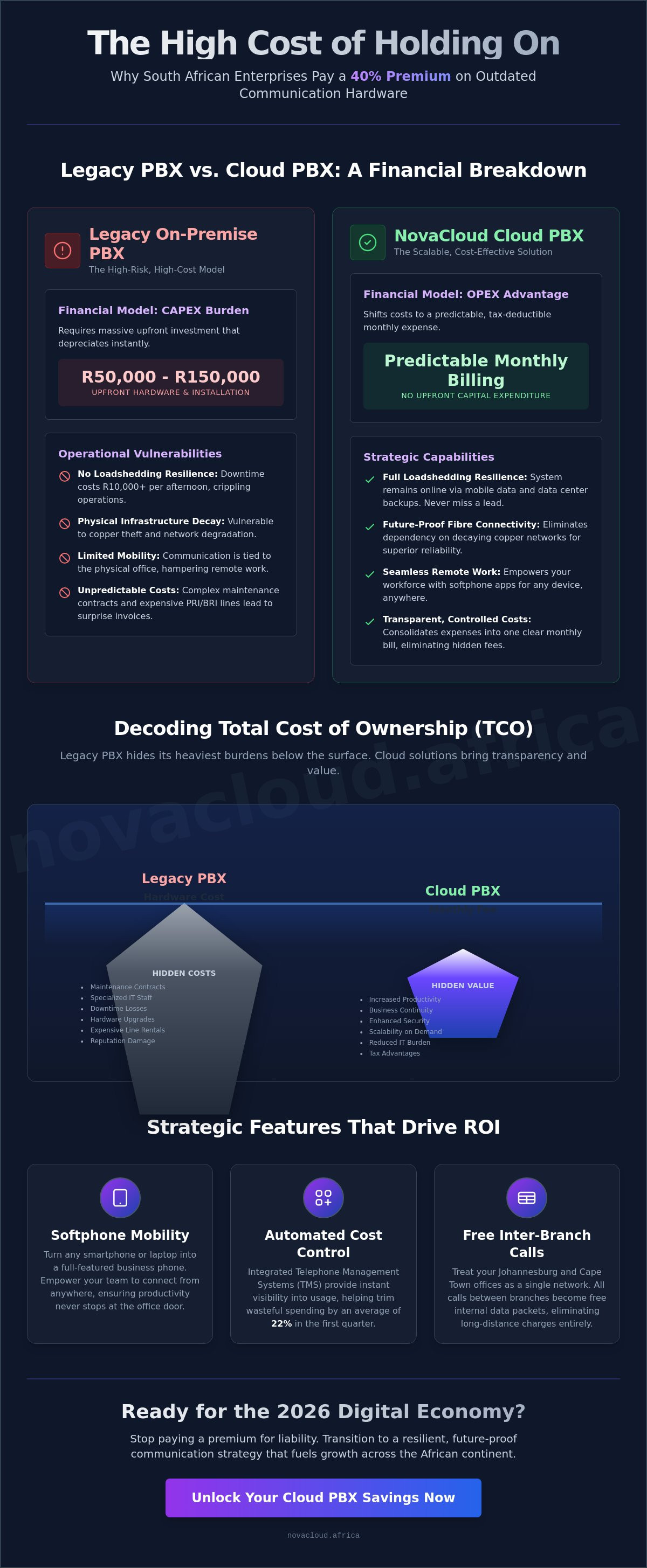
Traditional telephony requires a massive injection of capital before the first call is even placed. A standard on-site PBX for a medium-sized office in Johannesburg might demand R50,000 to R150,000 for servers, dedicated wiring, and proprietary handsets. This is a frozen asset that depreciates the moment it's installed. Cloud PBX shifts this burden to a predictable monthly subscription, turning a heavy capital expenditure (CAPEX) into a flexible operational expense (OPEX). For South African businesses, this shift is strategically advantageous. Under current SARS guidelines, operational costs are generally fully deductible in the year they're incurred, providing an immediate tax benefit that ownership models can't match.
The Cost of Inaction: Legacy Infrastructure Decay
Staying with analogue systems isn't a neutral choice; it's a high-risk gamble. As South Africa's copper network continues to face decommissioning and theft, the reliability of legacy hardware plummets. A single afternoon of downtime can cost a professional services firm upwards of R10,000 in lost billable hours and damaged reputation. Infrastructure liability is the hidden, compounding cost of maintaining obsolete systems that no longer serve the growth of the business. By migrating to the cloud, organizations shed this liability and replace it with a scalable, future-proof framework that evolves alongside global standards.
Decoding the Total Cost of Ownership (TCO) Model
True financial clarity in 2026 demands a shift from looking at simple monthly bills to analyzing a holistic Total Cost of Ownership (TCO). Traditional telephony often hides its heaviest burdens in maintenance and hardware decay. Cloud PBX savings emerge when you quantify the resilience of your infrastructure against local challenges like loadshedding. When the grid fails, a cloud-hosted system continues to function via mobile data or backup power at the data center level, ensuring your sales team never misses a R5,000 lead due to a dead desk phone. This continuity keeps your revenue stream fluid while competitors go dark during Stage 4 outages.
Internal routing transforms how multi-branch South African enterprises operate. By treating every branch as a single network entity, you eliminate the cost of calls between your Johannesburg and Cape Town offices. These calls shift from billable minutes to free internal data packets. Additionally, integrated Telephone Management Systems (TMS) provide automated reporting that flags high-usage patterns instantly. This visibility allows managers to trim wasteful spending by roughly 22% within the first three months of implementation.
Direct vs. Indirect Savings
Direct savings are visible on day one. You'll notice the total absence of legacy line rentals and a sharp decrease in per-minute call rates. However, the strategic value lies in indirect gains. Staff productivity rises when employees use a single identity across devices, whether they're in the office or working from home. You can review the specific tools that enable this flexibility on our Hosted PBX systems page. Reducing the time your IT team spends on phone configuration allows them to focus on high-value digital transformation projects instead of basic troubleshooting.
The Hidden Costs of Traditional Maintenance
Legacy PBX hardware is a recurring drain on resources. A single technician call-out to fix a physical card failure or update software can cost upwards of R950 per visit, excluding parts. Cloud-based systems eliminate these recurring headaches through seamless, over-the-air firmware updates. Your system stays current without a service van ever pulling into your parking lot. By moving to a resilient architecture that incorporates managed security, you protect your VoIP network from vulnerabilities without the need for manual on-site intervention. It's a cleaner, more predictable way to manage your communication budget while ensuring your tech stack remains at the cutting edge of the African market.
Strategic Efficiency: Features that Drive ROI
Maximizing ROI isn't about cutting corners; it's about intelligent automation. Manual switchboards are a legacy cost center that modern businesses can no longer justify. An Interactive Voice Response (IVR) or Auto Attendant system handles high call volumes with precision, eliminating the need for a dedicated receptionist salary that often exceeds R180,000 annually in the South African market. This automation drives strategic efficiency by routing callers to the correct department instantly, reducing wait times and improving the customer experience from the first second of contact.
Softphone applications represent another massive leap in Cloud PBX savings. By turning laptops and mobile devices into full-featured extensions, companies can bypass the R2,500 per-desk cost of traditional hardware for remote staff. These tools integrate directly into a high-performance inbound call center workflow, allowing your team to remain productive from any location with an internet connection. Additionally, integrated call recording simplifies compliance with South African regulations like POPIA and FICA. Instead of investing in expensive on-site storage servers, businesses utilize secure cloud archives, which slashes both capital expenditure and the administrative burden of manual audits.
Yealink Hardware Integration: Longevity and Performance
For offices that prefer physical handsets, the Yealink T31P IP Phone has emerged as a high-performance standard for 2026. It's built for durability, ensuring your hardware investment lasts for years rather than months. The inclusion of Power over Ethernet (PoE) support is a major cost-saver, as it allows the phone to draw power through the data cable. This removes the need for a qualified electrician to install new power points at every workstation, which can save a medium-sized office upwards of R15,000 in installation fees. Furthermore, zero-touch provisioning allows our team to configure devices remotely. You simply plug the phone in, and it's ready to use, eliminating the R1,500 call-out fee typically charged for on-site technical setups.
Scalability as a Cost-Saving Mechanism
The financial agility of the cloud is most evident when comparing expansion costs. Adding a new extension to a legacy PBX often requires purchasing physical expansion cards and paying for a technician's time, a process that can cost R5,000 or more per instance. With a cloud system, adding a user is a near-instant digital action with zero hardware overhead. This flexibility allows for seasonal scaling. A retail business can add 20 extensions for the December peak and remove them in January, ensuring they only pay for what they use. This unified architecture supports national growth without the need for regional hardware silos, creating a seamless communication fabric across all South African provinces.
Implementation and Connectivity: Optimising the Transition
Execution is everything. Moving your communications to the cloud requires a disciplined approach to ensure that the initial investment translates into long-term Cloud PBX savings. A botched migration leads to downtime, which costs South African mid-market firms an average of R15,000 per hour in lost productivity. To avoid this, we follow a rigorous four-step deployment framework that prioritises stability and user experience.
- Step 1: Network Audit. We verify that your local area network (LAN) and internet breakout are ready for high-definition voice traffic. This prevents jitter and dropped calls before they happen.
- Step 2: Number Mapping. We audit your current extensions and hunt groups. This ensures that every inbound call route is preserved or improved during the move.
- Step 3: Rapid Deployment. Modern systems allow for zero-touch provisioning. We deploy softphones to laptops and mobile devices instantly, while physical handsets are pre-configured before they reach your office.
- Step 4: Logic Configuration. We build your IVR (Interactive Voice Response) menus and ring groups to ensure calls reach the right person on the first attempt, reducing total call handling time.
Symmetrical Fibre: The Backbone of VoIP ROI
Reliable voice quality isn't accidental; it's a product of stable connectivity. Many businesses struggle with choppy audio because they rely on asymmetrical home-grade connections. For true Cloud PBX savings, investing in business-grade Cloud Infrastructure is a non-negotiable requirement. Symmetrical fibre provides equal upload and download speeds, which is vital because voice data travels in both directions simultaneously.
A single 50Mbps symmetrical line can comfortably support over 100 concurrent high-quality voice calls. This allows you to consolidate multiple legacy voice trunks into one resilient pipe. By eliminating the monthly line rentals of traditional copper infrastructure, you reduce fixed overheads while gaining the capacity to scale your team instantly. It's about building a foundation that supports transformative growth without the technical debt of the past.
Number Porting: Retaining Your Digital Identity
A common fear among South African business owners is the loss of established landline numbers. However, ICASA regulations allow for seamless number porting. We move your existing 011, 021, or 031 geographic numbers directly into the cloud environment. This process protects your brand equity and eliminates the massive hidden costs of updating marketing materials across the country.
Estimates suggest that a mid-sized firm would spend upwards of R45,000 to update signage, business cards, and digital directories if they were forced to change numbers. By porting, you retain your digital identity while gaining the flexibility to answer those same numbers from anywhere in the world. It's a strategic move that secures your history while enabling a more mobile, agile future for your workforce.
The NovaCloud Advantage: Resilient Communication
NovaCloud operates as an Innovative Architect within the South African ICT sector. We don't just supply software; we design the resilient digital backbones that allow local enterprises to compete globally. By aligning high-performance VPS hosting with managed security protocols, we ensure your communication infrastructure remains operational regardless of local power or connectivity hurdles. This holistic strategy is where genuine Cloud PBX savings are realized. It's not merely about reducing a monthly invoice. It's about stripping away the hidden costs of system downtime, fragmented vendor management, and technical friction.
Our commitment to local expertise ensures that your business isn't just another ticket in a global queue. We understand the South African regulatory environment and the specific nuances of the continental market. We build for the African context while maintaining global standards, positioning ourselves as a strategic ally rather than a distant vendor. This approach transforms your ICT stack from a cost center into a resilient asset designed for transformative growth.
Beyond the Phone Call: Unified ICT
Operational efficiency peaks when you bridge the gap between communication and daily workflow. Integrating Hosted PBX systems with Microsoft 365 Business Licensing creates a unified budget that simplifies financial forecasting. Instead of juggling five different invoices, you consolidate your spend into a single, predictable line item. This synergy eliminates redundant features and ensures your team uses a synchronized toolset. According to 2024 market insights from World Wide Worx, 63% of South African SMEs now prioritize consolidated ICT stacks to combat rising operational complexity.
Proactive support serves as the silent engine of this unified model. We focus on identifying bottlenecks before they impact your staff, reducing the long-term friction that often slows down digital adoption. Our role is to illuminate the path forward, ensuring your technology remains an enabler of progress. We see cloud technology as more than a utility; it's a catalyst for regional empowerment. By providing businesses with the same tools used by global giants, we help level the playing field for South African companies.
To begin your digital transformation, follow this clear pathway to 2026 readiness:
- Audit: Identify legacy hardware costs and hidden maintenance fees in your current setup.
- Consolidate: Merge your voice and productivity tools into a single, managed ecosystem.
- Secure: Implement resilient security layers that protect your data and your reputation.
- Scale: Use our continental reach to expand your footprint without increasing your physical overhead.
The transition to a cloud-first model represents a new star in your business journey. It's a bright beginning characterized by clarity, efficiency, and quiet confidence. With NovaCloud, your digital future is in expert hands, allowing you to focus on what matters most: your growth.
Secure Your Strategic Edge in the South African Digital Economy
The transition to unified communications is a fundamental shift toward business resilience. By 2026, the standard TCO model will favor agile, cloud-native frameworks that eliminate the heavy Rands spent on maintaining depreciating on-premise hardware. Realizing long-term Cloud PBX savings requires a partner who understands the unique pulse of the local market. NovaCloud provides this clarity through a 99.9% Uptime SLA and a national South African support network that keeps your operations fluid across every province. As an official Yealink Hardware Partner, we bridge the gap between global hardware standards and your specific connectivity needs. It's time to stop managing legacy limitations and start scaling with a platform designed for continental growth. Our team's ready to help you navigate this transformation with quiet confidence and technical precision.
Architect your future-proof communication with NovaCloud’s Hosted PBX
The future of your connectivity is bright, and it's built on a foundation of local expertise and visionary technology.
Frequently Asked Questions
How much can a business typically save by switching to Cloud PBX?
Businesses typically see Cloud PBX savings of 30% to 50% compared to traditional on-site hardware. These figures come from 2024 industry benchmarks analyzing South African telecommunications shifts. By eliminating expensive physical trunk lines and high per-minute local rates, you transform heavy capital expenditure into a predictable monthly operating model. This shift empowers your team to scale without the financial friction of legacy infrastructure.
Is there an upfront cost for installing a Cloud PBX system?
You can launch a Cloud PBX system with zero upfront capital expenditure for hardware. Unlike traditional PABX systems that require R20,000 to R100,000 for on-site servers, cloud solutions operate on a subscription basis. You only need compatible IP handsets or mobile apps. This low entry barrier allows South African SMEs to access enterprise-grade communication tools without depleting their cash reserves or taking on debt.
Can I keep my existing business phone number when moving to the cloud?
You can keep your existing business phone number through a process called geographic number porting. ICASA regulations ensure that South African businesses can move their 011, 021, or 031 numbers to a cloud provider seamlessly. This transition protects your brand identity and ensures customers don't lose contact during your digital migration. It's a straightforward administrative step that NovaCloud manages to ensure you experience zero downtime.
What happens to my Cloud PBX system during loadshedding?
Your Cloud PBX system remains fully operational during loadshedding because the core infrastructure lives in secure, power-redundant data centers. While your physical office might lose power, calls are automatically routed to mobile apps or redirected to branches with backup power. This resilience ensures your business stays connected to the South African market even when the local grid fails. It's a vital component of a modern disaster recovery strategy.
Do I need a specific type of internet connection for Cloud PBX to work?
A stable fiber-to-the-business or business-grade LTE connection is essential for high-quality voice calls. We recommend a minimum of 100kbps of dedicated bandwidth per concurrent call to ensure crystal-clear audio. By prioritizing voice traffic through Quality of Service settings, you prevent data-heavy tasks from interfering with your conversations. This technical foundation creates a seamless communication experience across your entire organization, regardless of where your team is located.
Is Cloud PBX cheaper than traditional landlines for international calls?
Cloud PBX systems offer international call rates that are often 80% cheaper than traditional landline providers. By routing calls over the internet rather than legacy copper networks, you bypass the high interconnect fees typically charged by old-school carriers. This makes global expansion a viable reality for South African firms. You can reach partners in London, Dubai, or New York for a fraction of the historical cost.
How does Cloud PBX reduce maintenance costs compared to on-premise systems?
Cloud PBX reduces maintenance costs by removing the need for on-site technician visits and physical hardware repairs. Since the system is hosted in the cloud, software updates and security patches happen automatically without any downtime. These Cloud PBX savings stem from eliminating the R1,500 call-out fees common with legacy systems. Your IT team can refocus their energy on strategic growth rather than fixing broken telephone wires or outdated servers.
Can I use my existing analogue phones with a Cloud PBX system?
You can use existing analogue phones by connecting them to an Analogue Telephone Adapter. This device bridges the gap between old hardware and modern VoIP networks, protecting your previous investments. While we recommend upgrading to IP handsets for full feature access, adapters provide a cost-effective bridge for a phased migration. It's a practical way to manage your budget while stepping into the digital future of South African business.
