


How to Master VPS Optimization: The Architect's Guide to High-Performance Hosting in 2026

Did you know that a 100-millisecond delay in server response can slash your conversion rates by 7%? In the fast-paced South African digital market of 2026, where every millisecond translates to Rands, your infrastructure is either a silent engine of growth or a hidden liability. You've likely felt the sting of unpredictable lag during peak traffic or felt overwhelmed by configuration files that seem designed for machines rather than people. It's frustrating to see your vision slowed down by technical bottlenecks that shouldn't exist.
This guide empowers you to master VPS optimization, transforming your virtual environment into a high-speed catalyst for your business. We'll show you how to move beyond basic setups to build a resilient architecture that scales effortlessly. You'll learn the specific hardware and software tuning techniques required to achieve sub-second load times and lower your operational costs by up to 15% through improved efficiency. We're moving from a state of technical uncertainty to one of absolute clarity and readiness for the future of the African cloud.
Key Takeaways
- Build a resilient foundation by leveraging NVMe storage and strategic geographic placement to eliminate latency and I/O bottlenecks across South Africa.
- Compare the performance of LAMP and LEMP architectures to select a high-concurrency software stack tailored for your 2026 growth objectives.
- Implement advanced VPS optimization strategies using HTTP/3 and Brotli compression to transform your data delivery into a high-speed catalyst for user engagement.
- Discover how managed security protocols and firewalls act as performance buffers, securing your infrastructure while simultaneously boosting server efficiency.
- Shift from the burden of granular DIY tuning to a partner-led ICT strategy that empowers your business through professional server management and local expertise.
Building the Foundation: Hardware and Geographic Optimization
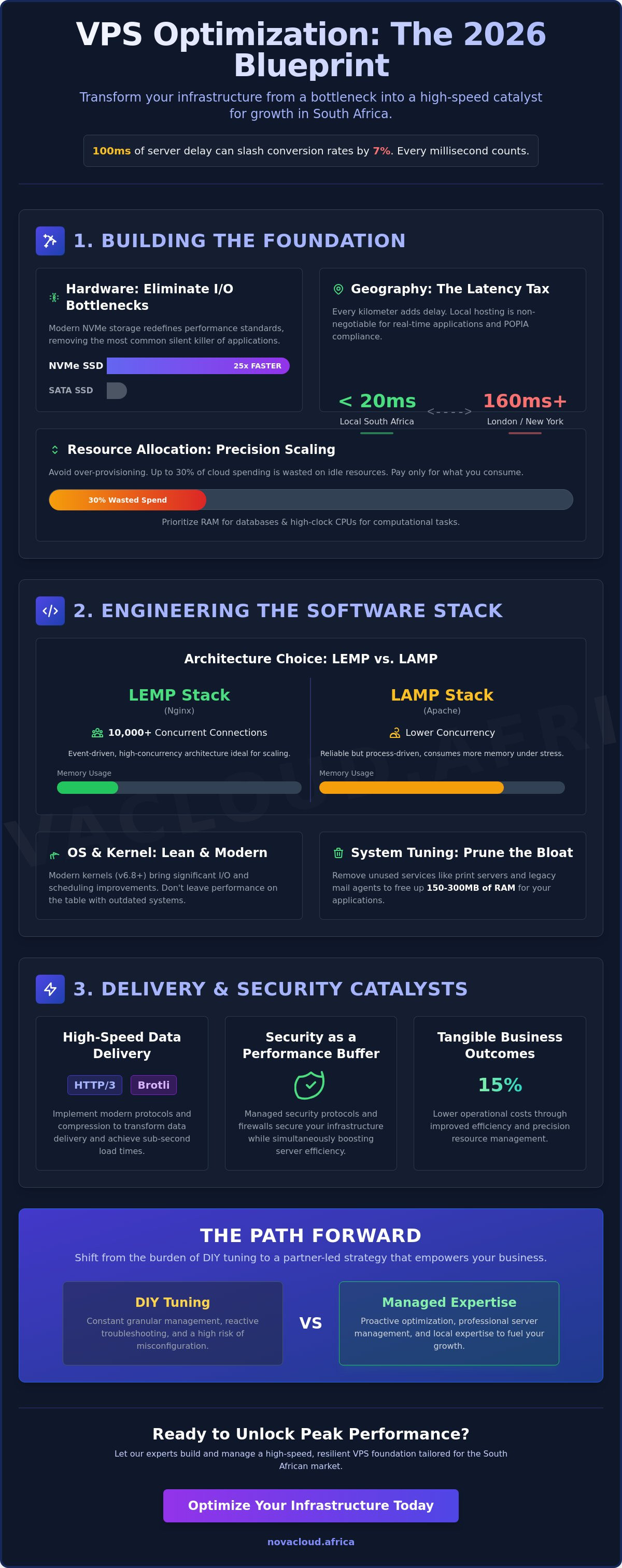
True high-performance hosting begins long before you tweak a configuration file. It starts with an architectural mindset. Most administrators fall into the trap of reactive troubleshooting, chasing bottlenecks only after they disrupt the user experience. A proactive approach to VPS optimization ensures your digital environment remains resilient as your traffic scales. This foundation relies on the underlying virtualization technology and the physical hardware supporting it. Modern NVMe storage has redefined these standards, offering read and write speeds up to 25 times faster than traditional SATA SSDs. By eliminating I/O wait times, your server processes requests instantly, removing the most common silent killer of application performance.
Geography is the second pillar of this foundation. Every kilometer of distance between your server and your user incurs a "Latency Tax." For South African enterprises, hosting data in London or New York adds a minimum of 160 milliseconds to every round-trip request. This delay compounds across complex applications, degrading the experience for local customers. Beyond speed, local hardware ensures your business remains aligned with POPIA requirements. Keeping sensitive data within South African borders isn't just a technical preference; it's a cornerstone of regional data integrity and regulatory compliance.
The Local Infrastructure Advantage
Proximity directly dictates the success of real-time applications. When you analyze the 2026 state of local cloud infrastructure, the trend is clear: regional data centers are no longer optional for mission-critical tasks. Reducing the number of network "hops" stabilizes sensitive systems like VoIP and PBX, where even minor jitter causes dropped calls or audio lag. For a Johannesburg-based firm, a local server delivers sub-20ms latency, creating a seamless interface that feels instantaneous. This responsiveness transforms digital tools from mere utilities into competitive advantages.
Resource Allocation Strategy
Effective VPS optimization requires finding the "sweet spot" between CPU power and RAM capacity. Many businesses fall into the habit of over-provisioning, which acts as a silent profit killer. Industry data from 2024 suggests that up to 30% of cloud spending is wasted on idle resources that never see utilization. Instead of rigid, legacy plans, modern cloud infrastructure allows for fluid scaling. You should prioritize RAM for database-heavy applications and high-clock-speed CPUs for computational tasks. This precision ensures you only pay for the performance you actually consume, allowing your budget to fuel growth rather than overhead. Scalability is about agility. Your foundation must be strong enough to support your peak load but flexible enough to shrink during the quiet hours.
The Software Stack: Engineering for Speed and Stability
Your choice of software stack dictates the ceiling of your performance. While the traditional LAMP (Linux, Apache, MySQL, PHP) stack remains a reliable workhorse, the 2026 growth landscape favors the LEMP stack. By replacing Apache with Nginx, you transition from a process-driven architecture to an event-driven one. This shift is vital for VPS optimization; Nginx can handle over 10,000 concurrent connections while consuming a fraction of the memory that Apache requires under similar stress. For South African enterprises scaling their digital footprint, this efficiency translates directly into lower latency for local users.
Stability begins with the kernel. Running an outdated OS like Ubuntu 20.04 in a 2026 environment leaves performance on the table. Modern kernels, such as version 6.8 and above, include significant improvements in task scheduling and I/O handling. Beyond updates, you must prune the bloat. Default installations often include print servers, legacy mail transfer agents, and unused network protocols that siphon off 150MB to 300MB of RAM. Removing these unnecessary services creates a leaner, more resilient environment that's easier to secure and faster to reboot.
Tuning the PHP and Database Engine
Standard PHP configurations are rarely optimized for high-volume South African e-commerce or SaaS platforms. You should implement PHP-FPM (FastCGI Process Manager) and tune the 'pm.max_children' settings based on your available RAM to prevent worker exhaustion. PHP-FPM functions as a process manager that creates isolated pools of workers to execute scripts, preventing a single runaway request from exhausting the server's entire memory bank. On the database side, focus on the MariaDB or MySQL InnoDB buffer pool. Setting this value to 70% of your total system memory ensures that data stays in RAM rather than forcing slow disk reads, which can accelerate query response times by 300% in read-heavy environments.
Modern Caching Architectures
Caching is the most effective way to achieve elite VPS optimization without over-provisioning hardware. Implementing OPcache is a non-negotiable step; it stores precompiled script bytecode in shared memory, which can reduce script execution time by up to 50%. For data-heavy applications, Redis outperforms Memcached by offering persistent data structures and superior handling of complex objects. These server-side layers ensure that your Virtual Private Servers spend less time recalculating the same data and more time serving your customers. If you want to see how a refined stack impacts your bottom line, you might consider how NovaCloud’s infrastructure supports these advanced configurations out of the box.
- Nginx: Best for high-concurrency and static file delivery.
- Redis: Ideal for session management and database query caching.
- PHP 8.3+: Delivers significant JIT (Just-In-Time) compilation improvements.
- Micro-caching: Reduces load on dynamic pages by caching them for brief intervals.
Network and Traffic Management: Streamlining Data Flow
High-performance VPS optimization requires more than internal tuning; it demands a surgical approach to how data traverses the network. By 2026, the adoption of HTTP/3 and the QUIC protocol has become non-negotiable for low-latency delivery. Unlike traditional TCP, QUIC uses UDP to eliminate head-of-line blocking. This reduces connection times by up to 48% on congested South African mobile networks, where packet loss is often a challenge for remote workforces.
Data density also dictates your server's efficiency. Implementing Brotli compression provides a 20% better compression ratio than standard Gzip for modern web assets like CSS and JavaScript. This reduces the payload size significantly, allowing your VPS to serve more concurrent users without inflating your bandwidth consumption. To protect your origin server, offloading static assets to a Content Delivery Network (CDN) ensures that roughly 80% of your traffic never touches your primary disk, preserving IOPS for critical database operations.
Mitigating Resource Drain from Malicious Traffic
Automated threats account for nearly 30% of all web traffic in the African enterprise sector. Identifying these through access logs allows you to spot "hotlinking" and aggressive scraping attempts that steal your CPU cycles. You shouldn't rely solely on robots.txt to manage these actors. Implementing server-level blocks or using security headers at the network edge is more effective. Offloading this "garbage" traffic ensures your VPS optimization efforts aren't wasted on processing illegitimate requests that offer no business value.
- Access Log Analysis: Monitor for 404 spikes that indicate brute-force directory scanning.
- Edge Firewalls: Use cloud-based firewalls to drop malicious packets before they reach your local network interface.
- Rate Limiting: Configure your server to restrict the number of requests per IP to prevent resource exhaustion during small-scale DDoS events.
Optimising for Unified Communications
For businesses running Hosted PBX systems, network stability is the difference between a closed deal and a dropped call. Prioritising SIP traffic ensures crystal-clear voice quality by preventing data-heavy web requests from crowding out sensitive voice packets. Your VPS must be configured to handle these real-time streams with absolute precision.
Reducing jitter and packet loss through network-level Quality of Service (QoS) tuning is essential. You want to keep jitter below 30ms and packet loss under 1% to maintain professional standards. This technical precision transforms a standard server into a resilient communication hub. For a deeper look at the local ecosystem and how to choose the right partner, consult our Hosted PBX Providers guide to see how these architectures scale within the South African market.
Security as an Optimization Catalyst
Security is often misunderstood as a performance tax that slows down processing speeds. This is a fundamental misconception in modern architecture. A secure environment is inherently a fast environment. Unfiltered traffic, malicious bots, and persistent brute force attempts can consume up to 30% of available server resources before a single legitimate user request is even processed. Effective VPS optimization starts with the realization that every blocked malicious packet is a CPU cycle reclaimed for your core business logic. By hardening the perimeter, you aren't just protecting data; you're clearing the path for high-velocity performance.
Managed Firewall Integration
Integrating enterprise-grade FortiNet infrastructure acts as a sophisticated buffer for your virtual environment. This external layer filters out the digital noise that typically clogs network interfaces. In 2024, South African enterprises saw a 25% increase in localized DDoS attempts, making edge-level filtering a necessity rather than a luxury. Proactive threat hunting at the firewall level prevents the massive resource spikes associated with these attacks. When the firewall handles the heavy lifting of deep packet inspection, your VPS remains lean and focused on execution. This synergy ensures that your infrastructure doesn't just survive traffic surges; it thrives under them.
Monitoring for Proactive Health
Visibility serves as the foundation for digital resilience. Real-time alerts for memory leaks or sudden disk I/O spikes allow architects to intervene before a performance degradation impacts the end user. Environment monitoring applications provide the clarity needed to visualize server trends over time. For instance, identifying a steady 15% climb in RAM usage over a seven-day period can pinpoint a specific application leak that a simple reboot would only temporarily mask. Historical performance data serves as a strategic blueprint, helping you architect future scalability with precision as your continental reach expands.
Leveraging lightweight tools like fail2ban and IP tables secures the perimeter without adding significant overhead. Fail2ban automates the process of scanning log files and banning IPs that exhibit malicious behavior, such as repeated failed login attempts. This automation reduces the manual burden on your team while keeping the kernel's processing power dedicated to high-value tasks. It's a surgical approach to security that reinforces the integrity of your hosting environment. Secure your digital future and experience the power of a refined architecture by exploring our high-performance cloud solutions today.
Scaling the Future: The NovaCloud Managed Advantage
True VPS optimization isn't a weekend project for your lead developer. It's a strategic pivot from reactive DIY troubleshooting to a partner-led ICT strategy. In the South African market, where connectivity and infrastructure stability are critical, relying on manual tuning can stall your growth. NovaCloud Africa removes the burden of granular server management, allowing your technical team to focus on innovation rather than infrastructure maintenance. We act as the technical executor for your vision, ensuring your environment remains lean and high-performing.
The roadmap for your digital journey begins with a single, well-tuned VPS. However, as your user base expands, the transition to a resilient cloud cluster becomes inevitable. This shift isn't just about adding more resources; it's about architecting a system that handles 2026-level demands without breaking a sweat. By offloading the complexities of kernel patches and resource allocation to experts, you secure a foundation built for transformative growth. NovaCloud Africa represents a bright beginning for enterprise digital transformation, offering a path that's both aspirational and precise.
Strategic Growth and Scalability
Preparing for 'burst' events, such as month-end transaction spikes or massive e-commerce sales, requires more than just extra bandwidth. Our approach ensures your infrastructure scales automatically to meet demand. We create a unified business ecosystem by integrating M365, high-speed Fibre, and Cloud services into a single point of management. This synergy eliminates the friction of fragmented vendors. Expert licensing support ensures you aren't overspending on unused seats, while our hardware expertise guarantees your office remains a high-efficiency hub. It's about building a resilient architecture that supports rapid market expansion across the continent while maintaining 99.99% uptime.
Your Next Chapter in Performance
Professional management is the ultimate VPS optimization hack for busy executives. It transforms your IT department from a cost center into a growth engine. By adopting the Innovative Architect approach, you ensure your business remains agile in an unpredictable landscape. This isn't just about hosting. It's about a bright beginning for your enterprise. We provide the clarity and technical authority needed to navigate complex cloud landscapes, tethering global standards to the local South African context.
Your journey toward digital resilience doesn't have to be a solitary path. It's time to trade the stress of server logs for the confidence of a managed partnership. Every millisecond of latency saved is a step toward market leadership. Start your new chapter with a strategy designed for the future of African enterprise.
Own the Future of African Infrastructure
Realizing the full potential of VPS optimization in 2026 demands more than basic maintenance; it requires a visionary approach to digital architecture. By anchoring your assets in business-grade cloud infrastructure with local low-latency connectivity, you eliminate the 150ms delays often found in overseas routing. A resilient architecture designed for South African enterprise scalability ensures your platform remains stable during peak traffic surges, providing a foundation that grows with your ambitions. Our team provides expert IT assistance for seamless server migrations, removing the technical friction that often stalls transformative growth.
This transition isn't just about speed; it's about empowering your brand to lead a new era of regional digital empowerment. You've seen the blueprint for high-performance hosting. Now it's time to build. Architect your high-performance VPS environment with NovaCloud Africa today. The digital horizon is bright, and your business is ready to shine. We're here to ensure your journey is efficient, secure, and entirely limitless.
Frequently Asked Questions
What is the single most effective way to speed up a VPS?
Implementing server-side object caching, specifically through Redis, is the most effective way to accelerate your server. This reduces database load by up to 80 percent, allowing your system to serve content from memory rather than slower disk storage. For businesses in South Africa, this ensures local applications respond in under 200 milliseconds. It's a transformative step for any growing digital infrastructure.
How much RAM does my VPS actually need for business applications?
Most South African SMEs require a minimum of 4GB of RAM for basic web applications, though 8GB is the recommended baseline for 2026 performance standards. If you're running resource-heavy ERP systems or high-traffic e-commerce platforms, aim for 16GB to ensure seamless integration of all services. Insufficient memory causes swapping to disk, which can increase page load times by 300 percent.
Will a CDN really help if my customers are all based in South Africa?
A CDN is vital because it offloads static assets and provides local Points of Presence in Johannesburg and Cape Town. Even if your users are strictly local, using a CDN can reduce the load on your primary server by 60 percent. This creates a resilient architecture that handles traffic spikes during regional events or sales without compromising your core VPS resources or speed.
What is the difference between LAMP and LEMP stacks for performance?
The LEMP stack, utilizing Nginx, typically outperforms the traditional LAMP stack by handling 2.5 times more concurrent connections with lower memory overhead. While Apache is versatile, Nginx's event-driven architecture is superior for modern VPS optimization strategies. Choosing LEMP allows your infrastructure to scale efficiently as your South African customer base expands, providing a more stable foundation for high-traffic environments.
How do I know if my VPS is being slowed down by a cyberattack?
You can identify a cyberattack by monitoring for unusual CPU spikes that exceed 90 percent for sustained periods without a corresponding increase in legitimate traffic. Check your access logs for repetitive requests from specific IP ranges, often originating from compromised global botnets. Implementing a Web Application Firewall can block these floods, protecting your server's integrity and maintaining your continental reach without interruption.
Can I optimize my VPS for both web hosting and Hosted PBX simultaneously?
You can optimize a single VPS for both web and Hosted PBX by implementing strict Quality of Service rules to prioritize voice traffic. Voice packets require jitter levels below 30ms to remain clear and professional. We recommend partitioning your CPU cores so that your PBX services have dedicated cycles. This ensures your digital communication remains crystal clear while your website continues to handle visitors.
Is it better to optimize my current VPS or just upgrade to a larger plan?
Optimizing your current environment is the strategic first step if your resource utilization sits below 70 percent. If your server consistently hits its hardware ceiling despite clean code and caching, then an upgrade is necessary for transformative growth. A well-configured VPS optimization strategy can often yield a 40 percent performance increase, delaying the need for more expensive hardware and saving your business money.
How often should I perform a performance audit on my server environment?
Conduct a comprehensive performance audit every 90 days to ensure your architecture remains aligned with your business goals. Regular checks help identify zombie processes or bloated logs that accumulate over time, slowing down your response rates. Staying proactive prevents technical debt and ensures your South African enterprise maintains its competitive edge. It's about constant illumination of your system's efficiency and potential.
