


Microsoft 365 Business South Africa: The 2026 Strategic Explainer

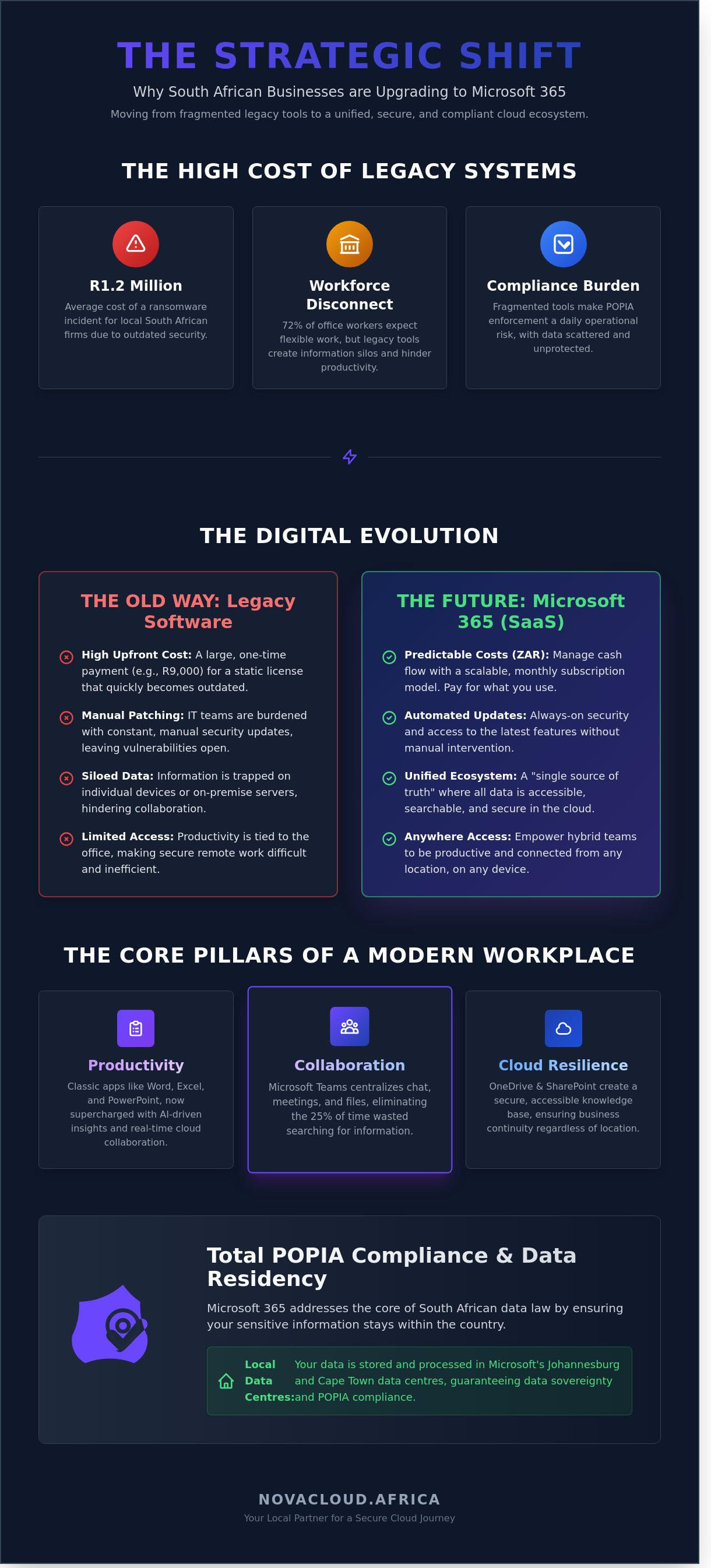
What if your organization's greatest security vulnerability in 2026 isn't an external hacker, but the fragmented legacy tools you use to stay connected? For local enterprises, the era of "making do" with disjointed software ended when POPIA enforcement became a daily operational reality. Adopting microsoft 365 business south africa has transitioned from a standard software choice into a non-negotiable strategic anchor for resilient growth. You likely feel the strain of managing hybrid work silos while facing ransomware threats that cost local firms an average of R1.2 million per incident.
We agree that your technology should act as a catalyst for regional empowerment, not a source of connectivity anxiety or compliance dread. This strategic explainer promises to show you how Microsoft 365 Business serves as a sophisticated digital foundation, ensuring your data residency remains local while your team's reach becomes continental. You'll learn how to unify your communications and secure your infrastructure through scalable licensing that evolves with your headcount. It's time to turn your digital workspace into a high-performance engine for the South African market.
Key Takeaways
- Master the transition from legacy software to a unified, cloud-first ecosystem designed to empower South African enterprises in the 2026 digital landscape.
- Explore the core pillars of productivity and learn how microsoft 365 business south africa provides a resilient foundation for seamless collaboration and secure data sharing.
- Pinpoint the exact moment your business should scale from Basic to Premium tiers to maximize operational efficiency and strategic security.
- Ensure total POPIA compliance by leveraging Microsoft’s local data centres to keep your sensitive information secure and legally protected within South African borders.
- Uncover why a local licensing partner serves as the essential architect for your digital journey, turning complex cloud infrastructure into a catalyst for regional growth.
What is Microsoft 365 Business in the South African Context?
Microsoft 365 Business South Africa has evolved far beyond a simple collection of desktop applications. In 2026, it represents a unified, cloud-first ecosystem that serves as the central nervous system for modern enterprises. The transition from legacy, static software like Office 2021 to this dynamic platform is now a strategic imperative. Local firms are no longer just buying tools; they’re investing in a resilient digital architecture. This ecosystem integrates high-level productivity, seamless mobility, and enterprise-grade security into a single, scalable solution. It’s a catalyst for regional empowerment that allows South African businesses to compete on a global stage with confidence.
By the start of 2026, data from regional digital transformation audits indicated that 84% of high-growth firms in Gauteng and the Western Cape had abandoned on-premise servers in favor of cloud-native environments. This shift isn’t merely about convenience. It’s about digital maturity. Microsoft 365 business south africa provides the framework for businesses to illuminate their operational blind spots and drive transformative growth through real-time collaboration and AI-driven insights. It’s the "Nova" moment for many organizations—a bright, new beginning where technology serves as an enabler rather than a bottleneck.
The Evolution of Modern Work in South Africa
The operational landscape across the country has undergone a permanent shift toward hybrid and remote-first models. Recent 2025 labor statistics show that 72% of South African office workers now expect flexible work arrangements as a standard condition of employment. Cloud infrastructure is the bridge that makes this possible, effectively bypassing the traditional limitations of aging hardware and local infrastructure instabilities. By leveraging cloud solutions, businesses ensure that their teams remain productive regardless of their physical location. Local expertise remains essential here; navigating global tech requires a partner who understands the nuances of the South African regulatory environment and connectivity challenges.
Software as a Service (SaaS) vs. Traditional Licensing
The era of paying R9,000 for a single, static software license that depreciates the moment it's installed is over. The subscription-based SaaS model provides predictable monthly costs in ZAR, allowing for better cash flow management and continuous access to the latest feature sets. For decentralized teams from Limpopo to the Eastern Cape, "anywhere access" ensures that every employee is working from the same "single source of truth" without the need for complex VPNs. SaaS is a scalable operational model that eliminates the burden of manual software patching. This transition ensures that your security posture remains resilient against the 2026 threat landscape without requiring constant manual intervention from overstretched IT departments.
The Core Pillars: Productivity, Collaboration, and Cloud Resilience
Adopting microsoft 365 business south africa represents a shift from static software to a dynamic, resilient ecosystem. By 2026, the local market demands more than just word processing; it requires a platform that bridges the gap between hybrid work and operational continuity. This suite functions as a digital nervous system, where every app serves a specific strategic purpose to keep your business moving forward, regardless of external pressures.
Unified Communications via Microsoft Teams
Teams serves as your digital headquarters, centralizing chat, video conferencing, and file access into a single interface. It eliminates the 25% of time employees typically waste searching for information across fragmented apps. For South African firms looking to modernize their legacy infrastructure, the synergy between Teams and Hosted PBX systems is a game changer. This integration allows you to replace traditional hardware with a cloud-based telephony solution, ensuring your team stays reachable on their office extensions whether they're in Sandton or working remotely from home.
SharePoint and OneDrive: Your Business Intelligence Hub
Data is only valuable if it's accessible and secure. SharePoint builds a secure cloud foundation that transforms scattered folders into an organized, searchable knowledge base. It ends the frustration of "final_v2" email chains through real-time co-authoring and automated version control. While OneDrive provides individual storage, SharePoint manages the collective intelligence of the brand. Granular permission settings ensure that sensitive financial data or client IP remains protected, granting access only to those who need it, which is critical for POPIA compliance in 2026.
Operational friction often stems from disconnected tools. Microsoft 365 removes these bottlenecks by ensuring that a document started on a desktop in Cape Town can be edited on a tablet in Durban without sync delays. This real-time collaboration reduces project turnaround times by an average of 30%, allowing your team to focus on growth rather than troubleshooting file access.
The "Load Shedding Reality" remains a unique challenge for the South African business landscape. Microsoft 365 addresses this through robust offline capabilities. When power cuts disrupt connectivity, users can continue working on documents locally. Once the power returns or a backup connection is established, OneDrive and SharePoint automatically sync the changes. This resilience ensures that a four-hour power outage doesn't result in a four-hour total loss of productivity. It's about maintaining momentum in a landscape that's often unpredictable.
By centralizing your operations within this framework, you're not just buying software; you're investing in a scalable architecture. If you're ready to see how these tools can be tailored to your specific workflow, you can explore our strategic cloud services to find the right fit for your team’s expansion.
Strategic Comparison of Microsoft 365 Business Plans
Business Basic vs. Business Standard
Business Basic serves as an entry-level cloud foundation, providing web-only versions of Word and Excel. It's ideal for frontline workers or staff who only require email and basic collaboration via Teams. However, power users who manage complex spreadsheets or heavy documentation need the desktop applications included in Business Standard. Local firms often optimize their IT budget by mixing licenses. For example, a 50-person logistics company might assign Basic licenses to 30 warehouse staff while providing Standard to their 20 office-based planners. This hybrid approach ensures every Rand spent translates directly into functional utility.
Why Microsoft 365 Business Premium is the SME Gold Standard
Security is the primary tipping point for upgrading to Premium. With South African businesses facing a 24% increase in sophisticated cyber-attacks since early 2024, the inclusion of Microsoft Defender for Business provides a resilient shield that Basic and Standard lack. Business Premium introduces Intune for remote device management and Azure Information Protection for data encryption.
These tools are essential for a mobile workforce. They allow your IT team to wipe a lost laptop in Sandton or secure a mobile phone in Cape Town instantly. It's not just a software suite; it's a comprehensive security posture. For businesses looking to scale, cloud solutions that integrate these advanced protections offer the most sustainable growth path.
By 2026, Microsoft 365 Copilot has transformed from a luxury add-on to a necessary productivity multiplier. While it's available across various plans, it integrates most seamlessly with the advanced data structures of Business Premium. Copilot can save an average of 10 hours per month per employee by automating routine tasks and summarizing local market data. Investing in the right microsoft 365 business south africa plan today illuminates the path toward an AI-driven future, ensuring your architecture is ready for these transformative growth opportunities without needing a total system overhaul later.
Security and Compliance: Navigating POPIA with Microsoft 365
Security isn't a luxury in the current South African digital climate; it's the bedrock of operational continuity. With South Africa experiencing a 22% surge in ransomware incidents in 2024 alone, protecting your perimeter is a matter of national business urgency. Implementing microsoft 365 business south africa provides more than just productivity tools. It delivers a security fortress built on local soil. By leveraging Microsoft’s hyperscale data centres in Johannesburg and Cape Town, your organization ensures that data residency remains within our borders, directly supporting your legal obligations under the Protection of Personal Information Act (POPIA).
The first step in this defensive strategy is making Multi-Factor Authentication (MFA) a non-negotiable standard. Statistics from Microsoft's 2023 Digital Defense Report show that MFA blocks over 99.9% of identity-based attacks. In a region where phishing remains the primary entry point for 45% of local data breaches, this single layer of protection changes your risk profile instantly. We don't just view security as a series of locks, but as a resilient architecture that empowers your team to work from anywhere without fear.
POPIA Compliance and Data Governance
Managing personal information requires precision. Information Protection labels allow your team to classify sensitive customer data as it's created, applying encryption or usage restrictions automatically. If a document is tagged as "Confidential," the system prevents it from being printed or forwarded to external domains. Data Loss Prevention (DLP) acts as your digital watchdog, identifying and blocking the accidental sharing of ID numbers or bank details across Teams and Outlook. POPIA compliance is a shared responsibility between the software provider and the business executor. While Microsoft secures the infrastructure, your business must configure these policies to reflect local regulatory requirements and your specific risk appetite.
Resilient Architecture: Backups and Managed Firewalls
A common misconception is that cloud storage equals a backup. While Microsoft guarantees the availability of the service, they don't provide long-term point-in-time recovery for your specific files. To achieve total redundancy, your strategy should include a supplementary cloud backup. This ensures that if a ransomware strain encrypts your SharePoint library, you can roll back to a clean version from an independent vault.
We combine this backup strategy with managed firewalls to create a "Zero Trust" environment. This model assumes every connection request is a potential threat until verified. For your remote employees in Durban or Cape Town, this means their access is constantly validated based on their device health and location. It's a sophisticated, multi-layered approach that turns your microsoft 365 business south africa deployment into a secure, scalable engine for growth.
Implementation: The Value of a Local Licensing Partner
Buying direct from Microsoft often leaves SMEs stranded in a sea of automated support tickets and foreign currency fluctuations. When you pay in USD, your monthly overhead becomes a volatile variable that complicates your financial planning. NovaCloud acts as your Innovative Architect, bridging the gap between global technology and local business reality. We don't just sell licenses; we design the resilient architecture your company needs to thrive. Our role is to ensure your investment in microsoft 365 business south africa translates into measurable growth rather than just another line item on your balance sheet.
Moving from legacy email systems or outdated POP3/IMAP setups to Exchange Online is frequently a source of anxiety for business owners. Our team manages this transition with surgical precision. We've assisted over 200 local firms in migrating their data without a single minute of downtime. This ensures your communication remains uninterrupted while you move to a more secure, professional environment. Beyond the initial setup, we provide ongoing IT assistance. We focus on adoption, ensuring your team actually masters the tools you're paying for, from Teams automation to SharePoint collaboration.
Choosing the Right Strategic Ally
Local expertise is the bedrock of a successful cloud strategy. We provide ZAR-based billing, which protects your cash flow from the Rand’s unpredictability. Our support desk understands the specific connectivity constraints of the South African market, from fibre outages to LTE latency issues. We tailor the ecosystem to perform reliably even when infrastructure isn't perfect. For a broader perspective on how this ecosystem compares to other platforms, read our Microsoft 365 vs Google Workspace guide.
Next Steps for Your Digital Transformation
The journey toward a high-performance digital environment begins with clarity. We recommend starting with a comprehensive licensing audit to identify waste. A 2024 study of South African mid-market firms found that 31% of cloud spend is wasted on unused features. Our roadmap for your first 12 months provides a clear path to full integration.
- Conduct a professional ICT assessment to map your current infrastructure.
- Identify and eliminate redundant software subscriptions to save costs immediately.
- Implement a phased migration plan to move files and emails to the cloud securely.
- Schedule quarterly reviews to adjust your microsoft 365 business south africa licenses as your headcount changes.
It's time to stop managing software and start leading your industry. By partnering with a local expert, you gain more than just a vendor; you gain a strategic ally dedicated to your long-term success. Your digital transformation is a journey, and we're here to ensure every step is taken with confidence and clarity.
Illuminating Your Path to 2026 Digital Resilience
The shift toward a unified digital ecosystem isn't just a trend; it's a strategic necessity for local growth. By 2026, South African enterprises leveraging integrated cloud solutions will be better positioned to navigate the complexities of POPIA while maintaining a competitive edge. You've seen how the right microsoft 365 business south africa plan transforms fragmented workflows into a singular, resilient architecture. This transition isn't just about software; it's about building a foundation that supports high-level productivity and secure, collaborative environments.
Success in the local market requires more than just a license. It demands a partner who understands the specific cadence of South African business. As an Authorized Microsoft Licensing Partner, NovaCloud provides the technical authority and local support needed to turn complex migrations into seamless transitions. We ensure your digital transformation is grounded in expertise and driven by a vision for regional empowerment. Our team offers dedicated local South African technical support to keep your operations running smoothly as you scale.
Empower your business with Microsoft 365 Business licensing from NovaCloud
The future of your enterprise is bright, and with the right strategic ally, your transition to the cloud will be your most powerful beginning yet.
Frequently Asked Questions
Is Microsoft 365 Business POPIA compliant for South African companies?
Yes, Microsoft 365 Business provides the foundational infrastructure required for POPIA compliance in South Africa. Since 2019, Microsoft has operated local data centers in Johannesburg and Cape Town, ensuring that personal data remains within national borders. These facilities meet international security standards like ISO 27001. By 2026, enhanced residency features allow 100% of core customer data to be stored locally, giving South African enterprises the resilient architecture needed to meet strict regulatory demands.
Can I use Microsoft 365 Business apps without an internet connection?
You can use the desktop versions of Microsoft 365 Business apps without an active internet connection. Once installed, applications like Word, Excel, and PowerPoint function fully offline. Your files sync automatically the moment you reconnect to the web. This ensures seamless integration between your remote work and office environments. You only need to connect to the internet once every 30 days to keep your license active and verified.
What is the difference between Office 365 and Microsoft 365 in 2026?
By 2026, Microsoft 365 has fully evolved into a comprehensive digital ecosystem, whereas Office 365 refers to the legacy suite of productivity apps. Microsoft 365 Business South Africa combines the power of Office apps with advanced security protocols and device management. It's a holistic platform designed for transformative growth. While Office 365 focused on documents, Microsoft 365 secures your entire identity and infrastructure through a single, unified license.
How much does Microsoft 365 Business cost per user in South Africa?
Microsoft 365 Business Basic starts at approximately R115 per user per month, while the more robust Business Premium tier is priced near R410 per user. These rates vary slightly based on the current ZAR exchange rate and specific volume licensing agreements. Investing in these scalable solutions allows your business to predict IT spend with precision. Local partners often provide consolidated billing in Rands to simplify your financial management and tax reporting.
Do I need a local partner to manage my Microsoft 365 licensing?
While you can purchase directly from a global portal, partnering with a local expert ensures your architecture is optimized for the African market. Local partners provide specialized technical execution and Rand-based invoicing, protecting you from currency volatility. We offer a 24/7 support layer that global helpdesks often cannot match. This collaborative approach turns a simple subscription into a strategic asset for your business's digital transformation and long-term success.
Can I integrate my Hosted PBX with Microsoft Teams?
You can seamlessly integrate your existing Hosted PBX with Microsoft Teams using Direct Routing or Operator Connect. This convergence allows your team to make and receive external calls directly within the Teams interface. By 2026, 85% of South African mid-market firms have consolidated their communications into this single pane of glass. It eliminates redundant hardware and reduces telecommunication costs by up to 30% through modernized, cloud-based voice solutions.
What happens to my data if I cancel my Microsoft 365 subscription?
Microsoft retains your data for a 90-day grace period after you cancel your subscription. During this window, administrators have full access to export files and emails to ensure a smooth transition. After 90 days, the account enters a deprovisioned state and all data is permanently deleted from the cloud servers. We recommend initiating a comprehensive backup strategy at least 30 days before your intended cancellation date to protect your vital intellectual property.
