


Ransomware Protection for Business: The 2026 Guide to Digital Resilience

What if the R5 million ransom demand sitting in your inbox isn't your biggest threat, but the 21 days of operational paralysis that follow? According to the 2024 Interpol African Cyberthreat Assessment, South Africa remains the primary target for digital extortion on the continent. You've likely felt the growing weight of this risk, especially since 62% of local firms reported an attack in the last twelve months. It's exhausting to balance global security standards with the specific demands of POPIA while costs for international software spiral out of reach. You want to grow your business, not spend your nights worrying about a total data wipeout.
At NovaCloud, we believe security should empower your expansion rather than drain your budget. This guide shows you how to architect a resilient strategy for ransomware protection for business that secures your South African enterprise against modern, AI-driven threats. We'll outline a clear 5-step action plan to achieve bulletproof recovery speeds and ensure your local compliance is handled with expert precision. It's time to move from a state of uncertainty to a future of digital clarity and transformative growth.
Key Takeaways
- Adapt to the 2026 threat landscape by evolving your ransomware protection for business from a single software tool into a multi-layered, resilient strategic framework.
- Deploy behavioral AI and advanced endpoint protection to detect anomalies and stop sophisticated "living-off-the-land" attacks before data encryption can even begin.
- Safeguard your digital assets with immutable cloud backups, ensuring your South African enterprise can recover data that remains untouchable by compromised admin accounts.
- Follow a structured five-step roadmap to audit your vulnerabilities and secure critical communication channels, shielding your organization from AI-driven social engineering.
- Partner with local architects who combine global security standards with a deep understanding of the African market to illuminate a secure path toward transformative growth.
Understanding Ransomware Protection for Business in 2026
Ransomware protection for business has evolved far beyond the boundaries of a simple antivirus installation. By 2026, digital resilience is defined as a multi-layered strategic framework that integrates proactive threat hunting, resilient architecture, and rapid recovery protocols. It's a holistic approach where technology and human strategy converge to safeguard the continuity of your operations. The focus has shifted decisively from "if we get attacked" to "how we respond when we are targeted," acknowledging that persistence is the hallmark of modern cybercrime.
In the first quarter of 2026, South African businesses faced a 48% increase in targeted attempts compared to the previous year. Local ICT infrastructure is often perceived as having exploitable gaps, making South Africa a testing ground for sophisticated global syndicates. Gaining a foundational Understanding Ransomware and its historical trajectory helps clarify why static defenses fail. Today, attackers utilize AI-driven social engineering to craft perfect phishing lures and "living-off-the-land" techniques that use a company's own administrative tools against itself. This makes detection incredibly difficult for traditional systems.
The Evolution of Ransomware: Beyond Simple Encryption
The days of simple data locking are over. Modern attackers now employ triple extortion tactics: they encrypt your files, steal sensitive data for public leak sites, and launch DDoS attacks to keep your website offline until payment is made. Traditional signature-based antivirus solutions can't keep pace with these polymorphic threats that change their code every few seconds. Modern ransomware is an automated business-disruption engine.
To counter this, a resilient architecture must focus on behavioral analysis rather than known file signatures. This shift allows systems to identify malicious intent, such as a sudden mass encryption event, and halt it in milliseconds. It's about building a digital environment that illuminates threats the moment they move within your network.
Why Business Size No Longer Protects You
While "Big Game Hunting" still targets major South African financial institutions, mass automated attacks now plague SMEs across the continent. Cybercriminals use AI bots to scan thousands of local IP addresses simultaneously, looking for any unpatched vulnerability. For a mid-sized firm in Cape Town or Johannesburg, the cost of downtime is often more lethal than the ransom itself. In 2026, the average cost of recovery for a South African business hit by ransomware is estimated at R2.8 million, excluding the ransom payment.
- POPIA Compliance: A breach triggers mandatory reporting to the Information Regulator, potentially leading to fines of up to R10 million.
- Legal Liability: Businesses now face increased litigation from clients whose personal data is exposed during double-extortion events.
- Reputational Damage: 64% of South African consumers state they would stop doing business with a company that fails to protect their data from cyberattacks.
Effective ransomware protection for business is an investment in your brand's future. It ensures that when a crisis hits, your digital infrastructure doesn't just survive; it recovers with a speed that preserves customer trust and operational integrity. We view this not as a technical burden, but as a catalyst for transformative growth and regional empowerment.
The 3 Pillars of a Resilient Cybersecurity Architecture
Digital resilience isn't built on luck; it's engineered through a multi-layered strategy. For a modern enterprise, effective ransomware protection for business requires a synchronized ecosystem where every component communicates in real time. This architecture rests on three critical pillars: prevention, detection, and recovery. When these elements align, security becomes an invisible enabler of growth rather than a bottleneck for performance. It's about creating a "seamless integration" where your team can work at pace, knowing the infrastructure is inherently secure.
Managed Firewalls: Your First Line of Defence
Traditional firewalls are no longer enough to stop sophisticated intrusions. We utilize FortiNet's high-performance technology to provide Managed Firewall Services that go beyond simple port blocking. Since over 85% of malicious traffic is now hidden within encrypted streams, deep packet inspection is a non-negotiable requirement for African businesses. These managed services filter threats at the perimeter, ensuring your local network remains a sterile environment for innovation. By outsourcing the management of these gateways, you gain access to expert configuration that adapts as quickly as the threat landscape changes.
Endpoint Detection and Response (EDR)
Static antivirus is dead. It can't stop "living off the land" attacks that use legitimate system tools against you. EDR monitors system behavior 24/7, using AI to spot anomalies like unauthorized credential harvesting or mass file renaming before encryption begins. This is especially vital in South Africa's hybrid work culture, where roughly 45% of employees access corporate data from home networks. By leveraging Microsoft 365 Business security features, you can manage every device from a single pane of glass. Following Ransomware and Data Extortion Prevention Best Practices ensures your endpoint strategy aligns with global standards while staying grounded in your specific operational needs.
Recovery: The Ultimate Safety Net
The final pillar is the ultimate safety net: recovery. In 2024, the average cost of a data breach in South Africa reached R49.7 million, a figure that makes downtime a terminal risk for many SMEs. Immutable cloud backups ensure that even if a breach occurs, your data cannot be altered, encrypted, or deleted by attackers. This creates a failsafe that allows for rapid restoration without paying a cent in ransom. This holistic approach ensures that ransomware protection for business isn't just about stopping a single file; it's about safeguarding your entire digital legacy. If you're ready to harden your perimeter, you can explore our resilient architecture solutions to see how we bridge the gap between technical complexity and business clarity.
Cloud Backups vs. Local Storage: Why Immutability is the New Standard
For decades, a physical server humming in the corner of the office felt like security. By 2026, that local box has become a primary target. Modern ransomware protection for business requires a fundamental shift from simple storage to resilient architecture. Local backups are excellent for quick file restores, but they lack the isolation needed to survive a sophisticated attack. If a hacker gains admin rights to your network, they can wipe your local backups before they ever encrypt your live data.
Immutability is the definitive answer to this vulnerability. It refers to data that's written in a "WORM" (Write Once, Read Many) state. Once your data hits the storage layer, it cannot be modified, encrypted, or deleted by any user account, even one with full administrative privileges. This creates a digital fortress. Hosting this data within South African data centres ensures your business remains fully compliant with POPIA regulations while maintaining the low-latency speeds required for rapid recovery. When your data stays on home soil, you avoid the legal and technical hurdles of international data transfer during a crisis.
This principle of creating a secure, centralized hub for critical information applies not just to businesses, but to personal life administration as well. For individuals and families looking to organize their most important documents in one secure place, platforms like SafeKeep offer a similar peace of mind.
Air-gapped digital storage provides the final layer of certainty. By creating a logical gap between your production environment and your backup repository, you ensure that malware cannot "hop" from one to the other. As highlighted in CISA's #StopRansomware Guide, maintaining offline or isolated backups is a non-negotiable requirement for modern digital resilience.
The 3-2-1-1 Backup Rule for 2026
The traditional 3-2-1 rule has evolved. You still need three copies of your data on two different media types with one copy offsite. However, the final "1" now stands for immutability. Our Cloud Backups are designed with this exact framework in mind. By integrating Acronis Cloud, we provide a unified solution that combines proactive cyber protection with immutable storage. This means your ransomware protection for business isn't just a reactive tool; it's a proactive shield that detects threats before they reach your archives.
Recovery Time Objective (RTO) vs. Recovery Point Objective (RPO)
Every business owner must calculate their maximum tolerable downtime. If your company loses R15,000 for every hour your systems are dark, a three-day recovery window is a R1.08 million disaster. RTO is the speed of your business’s return to light. It measures how long it takes to get back to work. RPO, on the other hand, determines how much data you lose, measured in time since your last backup. Using Virtual Private Servers (VPS) allows us to mirror your environment and restore critical applications in a fraction of the time it takes to rebuild physical hardware, ensuring your RTO remains measured in minutes, not days.
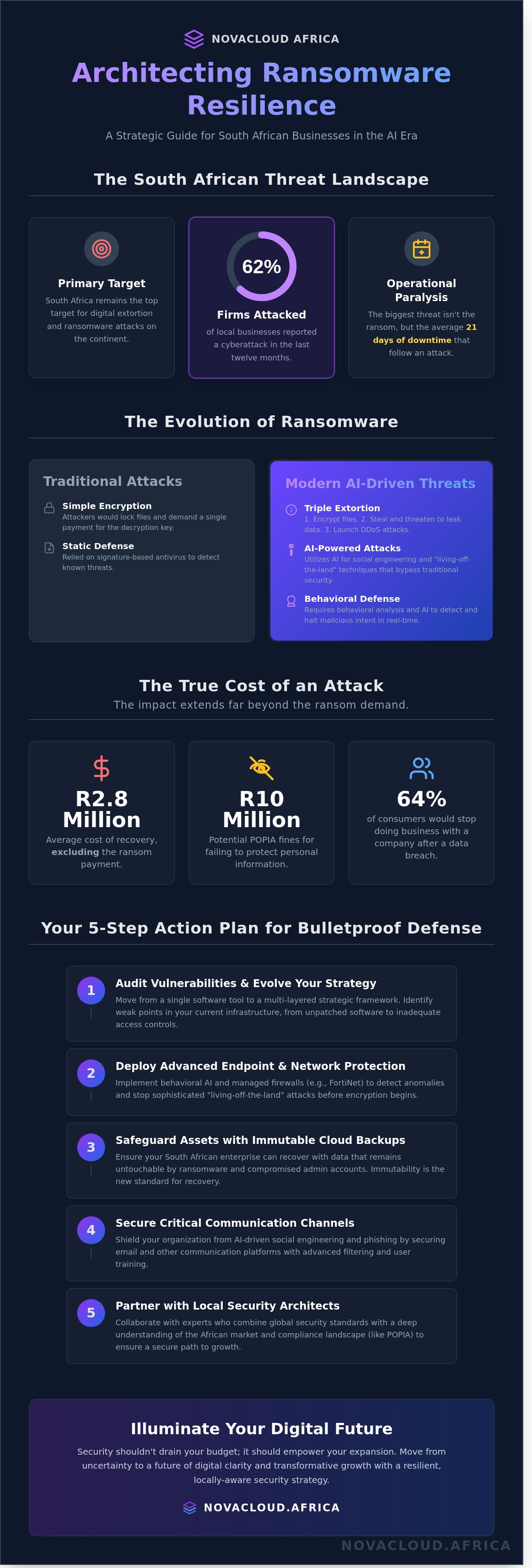
A 5-Step How-To Guide for Implementing Ransomware Defense
Building a resilient defense isn't about buying a single piece of software. It's a strategic architecture designed to withstand pressure. Effective ransomware protection for business requires a structured methodology that addresses both digital and human vulnerabilities. In South Africa, where the average cost of a data breach reached R49 million in 2024, these steps are no longer optional. They're the foundation of your survival.
- Step 1: Conduct a Vulnerability Audit. You can't protect what you can't see. Identify your "crown jewels," the critical data sets that keep your operations running. Map every entry point, from remote desktop protocols to legacy servers. 42% of local firms fail because they don't know where their most sensitive data resides.
- Step 2: Secure Your Communication Channels. Email remains the primary entry point, but hackers now target voice infrastructure too. Secure your email gateways with AI-driven filtering and ensure your VoIP traffic is encrypted to prevent interception.
- Step 3: Implement Zero Trust Access. Shift from a perimeter-based mindset to a "never trust, always verify" model. Use Multi-Factor Authentication (MFA) across every application. Strict licensing controls ensure that only authorized users access specific data silos.
- Step 4: Deploy Managed Security Layers. Combine next-generation firewalls with a 3-2-1-1 backup strategy: three copies of data, two different media types, one off-site, and one immutable (unchangeable) copy. This ensures that even if encryption occurs, your recovery is guaranteed.
- Step 5: Employee Training and Incident Response Testing. A plan is only as good as its execution. Run quarterly simulations to test your team's reaction to a breach. This reduces recovery time by 35% on average.
Securing the Human Element
Statistics from 2025 show that 90% of ransomware successful attacks start with a simple phishing email. Technology can block many threats, but your staff is the final firewall. Social engineering has evolved beyond email; attackers now target Hosted PBX systems to impersonate executives via high-quality deepfake audio. You must foster a culture of cyber-vigilance. Employees shouldn't fear reporting a mistake; they should feel empowered to flag suspicious activity immediately. This human-centric approach turns a potential liability into a strategic asset.
Leveraging Microsoft 365 for Security
Microsoft 365 Business Premium and E5 licenses provide built-in tools that simplify ransomware protection for business. By using centralized identity management, you can instantly revoke access across the entire organization if a device is compromised. When comparing M365 vs Google Workspace, Microsoft’s integrated Defender suite offers superior threat hunting capabilities for South African enterprises. It allows you to enforce MFA and conditional access policies from a single dashboard, ensuring that credential theft doesn't lead to a total network takeover.
Integrating these layers provides the most robust defense available in the current market. Don't wait for an incident to discover the gaps in your perimeter.
Illuminating Your Digital Future with NovaCloud Security
NovaCloud acts as the Innovative Architect for your digital expansion, transforming security from a restrictive cost into a catalyst for South African business growth. We provide the clarity required to see through the fog of modern cyber threats; we ensure your infrastructure is built on a foundation of absolute resilience. In a market where 72% of local firms faced ransomware attempts in the past year, comprehensive ransomware protection for business is no longer a luxury. It's the baseline for visionary leadership. We move beyond simple defense, designing cloud environments where security and performance exist in a state of perfect synergy.
Continental Reach, Local Expertise
Global security giants often struggle to address the unique volatility of the South African ICT landscape. They don't account for the impact of localized connectivity fluctuations or the specific regulatory pressures of POPIA. NovaCloud bridges this gap by combining world-class standards from partners like FortiNet, Acronis, and Microsoft with deep local insight. Our "Nova" promise represents a bright, secure beginning for your cloud journey, replacing uncertainty with technical precision.
This local expertise extends to every touchpoint of your network, including your hardware. We integrate secure endpoints like the Yealink T31P into our managed VoIP ecosystems. This ensures that your voice traffic remains encrypted and resilient, preventing communication channels from becoming entry points for lateral movement during a breach. By choosing a partner that understands the R100,000 per-hour cost of downtime in the local context, you gain a strategic ally committed to your operational continuity.
- Global Power: Integrated solutions using FortiNet's AI-driven threat detection.
- Local Grit: Redundant architectures designed to withstand regional connectivity challenges.
- Managed Excellence: End-to-end oversight of both cloud assets and physical hardware.
Next Steps: Your Security Assessment
The transition from vulnerability to visionary growth begins with a clear understanding of your current posture. NovaCloud provides managed security audits that go deeper than surface-level scans; we analyze the architectural integrity of your entire digital footprint. This assessment identifies the silent gaps where ransomware protection for business often fails, such as unpatched legacy systems or misconfigured cloud permissions. We don't just hand you a report. We provide a roadmap for transformative growth.
Our goal is to foster a long-term strategic partnership rather than a fleeting vendor relationship. As your business scales, your security architecture must evolve alongside it. Whether you are optimizing your remote workforce or migrating core databases, our team ensures that every step forward is a step into a secure environment. For those looking to unify their communication and security strategies, our Hosted PBX Guide offers deeper insights into building a connected, resilient enterprise. The future of your business is bright; let's ensure it stays protected. Connect with NovaCloud today to start your security audit and secure your place in Africa's digital future.
Illuminate Your Path to Digital Sovereignty
Digital resilience in 2026 isn't a luxury; it's a fundamental requirement for every South African enterprise. By integrating Acronis Immutable Backups, you ensure that your data remains untouched by malicious encryption attempts, providing a fail-safe that traditional storage lacks. When you pair this with FortiNet Managed Security, you create a multi-layered defense that identifies threats before they breach your perimeter.
Compliance is equally critical for long-term stability. Operating within POPIA-compliant South African Data Centres ensures your governance remains airtight while keeping latency low for local operations. Implementing a robust strategy for ransomware protection for business allows you to shift your focus from surviving crises to driving transformative growth. You've seen the 5-step roadmap; now it's time to execute. NovaCloud stands ready as your strategic ally, blending global standards with local expertise to illuminate your digital path.
Architect your digital resilience with NovaCloud’s secure cloud solutions today.
The future of the African digital landscape is bright, and your business deserves to lead the way with absolute confidence.
Frequently Asked Questions
What is the first thing a business should do after a ransomware attack?
Isolate the infected device from the network immediately. This prevents the lateral movement of malware to other servers or your primary cloud environment. Disconnect the ethernet cable and disable Wi-Fi, but keep the power on to preserve forensic evidence stored in the RAM. Contact your security partner to initiate a 2026-standard incident response protocol that secures your digital perimeter and starts the recovery process.
Does POPIA require businesses to have ransomware protection?
Yes, Section 19 of the Protection of Personal Information Act (POPIA) mandates that South African businesses implement appropriate, reasonable technical and organisational measures to prevent data loss. Implementing robust ransomware protection for business is no longer optional; it's a legal necessity to avoid regulatory penalties. Failure to comply can result in administrative fines of up to R10 million or 10 years of imprisonment for severe breaches.
Is a managed firewall enough to stop ransomware in 2026?
No, a managed firewall is just one layer of a resilient architecture. Modern threats bypass perimeters through social engineering or zero-day exploits that traditional hardware can't detect. You need a multi-layered approach including Endpoint Detection and Response (EDR) and immutable backups. Relying solely on a firewall leaves 70% of your internal network vulnerable to lateral movement once a single user account is compromised.
How often should our business test its cloud backup restoration?
You should perform a full restoration test at least once every 90 days. Testing ensures your Recovery Time Objective (RTO) meets your actual business requirements during a crisis. Data from 2024 shows that 30% of South African companies fail to restore their first backup attempt due to configuration errors. Frequent testing transforms a static backup into a dynamic safety net that empowers your digital growth.
Can ransomware infect my Microsoft 365 or Google Workspace files?
Yes, Ransomcloud attacks specifically target SaaS environments by using malicious OAuth permissions or compromised sync clients. If your local machine is infected, the encrypted files will sync directly to the cloud, overwriting your healthy versions in real time. Third-party cloud-to-cloud backup is essential to ensure your productivity suites remain resilient against these modern vectors. It provides a clean recovery point that exists outside your primary workspace.
What is the average cost of ransomware protection for a South African SME?
A comprehensive security stack for a South African SME typically ranges from R450 to R1,200 per user per month. This investment covers advanced endpoint protection, managed detection, and secure cloud storage. While this is an operational expense, it's a fraction of the R15 million average cost of a breach in South Africa. Investing in ransomware protection for business ensures your capital is spent on innovation rather than recovery fees.
To ensure your capital is managed effectively for such critical investments, it's helpful to use a modern financial platform; you can visit FunZ to see how their tools support business growth.
Why is immutable backup better than a standard cloud sync like Dropbox?
Immutable backups use Write Once, Read Many (WORM) technology that prevents any changes or deletions for a set period. Standard sync tools like Dropbox immediately mirror changes; if your files are encrypted, the cloud versions are encrypted too. Immutability creates a digital vault that hackers can't touch, even if they gain administrative credentials. This technology provides the ultimate assurance that your data remains pristine and recoverable.
How does a Virtual Private Server (VPS) help with disaster recovery?
A Virtual Private Server (VPS) acts as a standby environment where you can spin up critical applications in minutes during a local hardware failure. By maintaining a replicated image of your server in a secure South African data center, you reduce downtime from days to hours. It's the difference between a total business halt and a seamless transition to a secondary site. This architecture ensures your operations remain illuminated even during a crisis.
