


The Strategic Architect’s Guide to VPS Migration: A 2026 Case Study for South African Enterprise

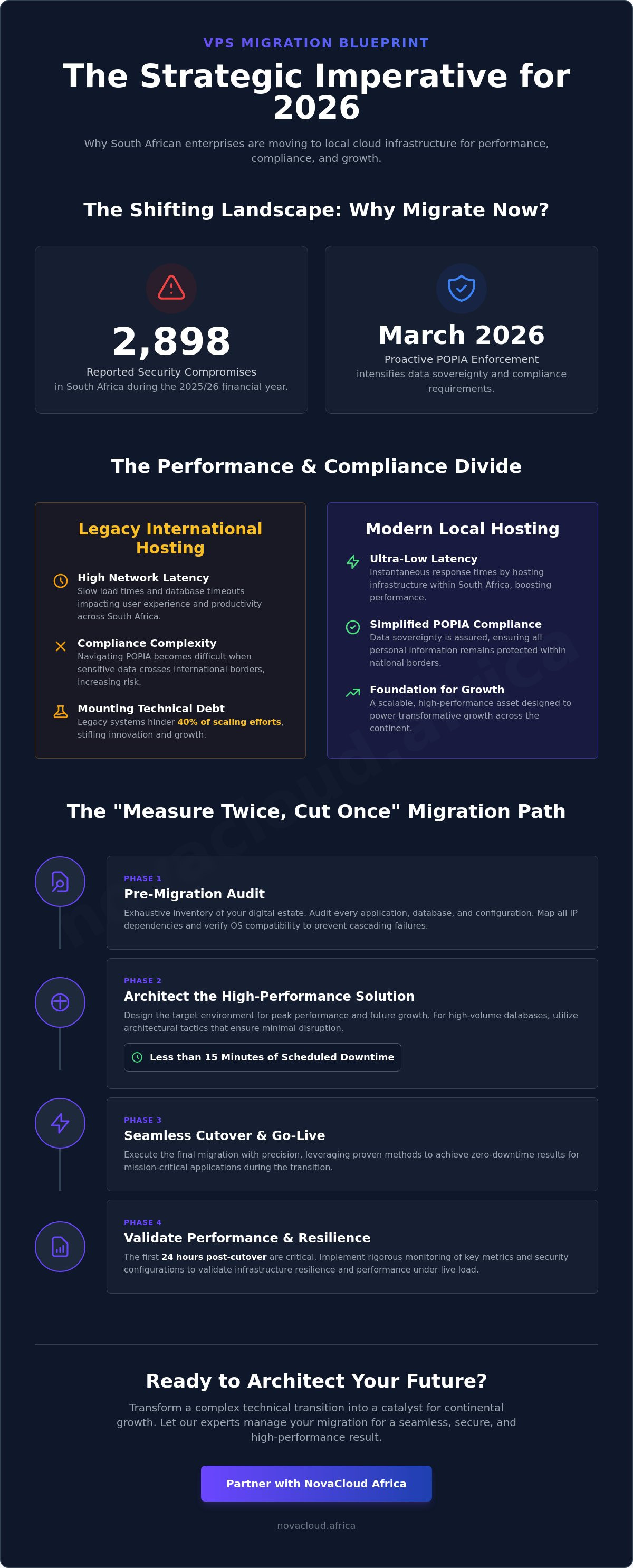
Security compromises in South Africa surged to 2,898 reported cases during the 2025/26 financial year, proving that your digital infrastructure is either a target or a fortress. For the strategic enterprise leader, a VPS migration isn't merely a technical task to check off a list; it's a pivotal moment to architect a more resilient, high-performance future. You likely feel the weight of this transition, fearing the potential for extended downtime or the complexity of manual database transfers that could jeopardize your data integrity.
We understand that moving mission-critical applications feels high-stakes, especially with the Information Regulator's March 2026 shift toward proactive POPIA enforcement. This guide promises a blueprint for a seamless transition that eliminates international latency and secures your local footprint. We'll walk through a 2026 case study showing how South African firms are leveraging local expertise to achieve zero-downtime results. You'll discover how to turn your server environment into a scalable asset that powers transformative growth across the continent.
Key Takeaways
- Understand why the "Local Cloud" is the definitive choice for South African enterprises seeking to reduce latency and ensure regional compliance.
- Master the "Measure Twice, Cut Once" philosophy to audit your applications and configurations before starting your VPS migration.
- Learn the specific architectural tactics used to migrate high-volume databases with less than 15 minutes of scheduled downtime.
- Discover the critical monitoring metrics and security configurations required to validate your infrastructure’s resilience in the first 24 hours post-cutover.
- Explore how expert IT assistance and managed cloud services can transform a complex technical transition into a catalyst for continental growth.
The Strategic Imperative for VPS Migration in 2026
A Virtual Private Server (VPS) provides the dedicated resources of a physical server within a virtualized environment, offering a balance between control and cost. However, VPS migration in 2026 isn't a simple lift-and-shift operation. It represents a strategic relocation of your entire virtual ecosystem to optimize both resilience and high-performance output. For many South African enterprises, the transition from aging international infrastructure to local providers has become a necessity rather than an option. According to The 2026 State of Local Cloud Infrastructure, 2026 marks a turning point where proximity to the end-user defines business agility. Legacy systems often carry hidden costs, including unpatched security gaps and mounting technical debt that hinders 40% of scaling efforts in high-growth sectors.
The landscape has shifted. While earlier cloud adoption focused on basic availability, modern digital architecture demands sophisticated, multi-layered solutions. Staying on legacy infrastructure means accepting higher risks of instability and slower response times. By architecting a move to a local VPS environment, you aren't just moving files; you're building a foundation for transformative growth and continental reach.
Recognizing the Performance Ceiling
Fatigue in your digital environment often shows up as inconsistent load times or database timeouts during peak South African business hours. If your current server sits in London or North Virginia, you're fighting a losing battle against physics. Latency is the time delay between a user's request and the server's response, which, in a South African B2B context, directly impacts transaction success rates and employee productivity. Moving your mission-critical applications to a local server environment eliminates these bottlenecks, ensuring your architecture remains a catalyst for growth rather than a constraint.
Compliance and the POPIA Factor
Data sovereignty has moved from a legal requirement to a core business imperative. With the Information Regulator reporting 2,898 security compromises in the 2025/26 cycle, the risk of non-compliance is at an all-time high. Local VPS migration simplifies the complexity of the Protection of Personal Information Act (POPIA) by ensuring sensitive data never leaves South African borders. This is particularly vital for finance and healthcare firms handling sensitive health-related personal information under the March 2026 regulations. Integrating robust cloud backups into your migration strategy ensures that even during a transition, your data remains protected and recoverable, meeting the strictest systematic compliance monitoring standards.
Architecting the Migration Path: Pre-Transfer Planning
Successful cloud architecture isn't built on hope; it's built on precision. The "Measure Twice, Cut Once" philosophy is the bedrock of a sophisticated VPS migration. Before moving a single byte of data, you must conduct an exhaustive inventory of your digital estate. This involves auditing every application, database, and configuration file to ensure nothing is left behind or broken in transit. In 2026, where digital ecosystems are increasingly interconnected, an oversight in pre-transfer planning can lead to cascading failures during the final cutover.
Choosing your target environment requires a forward-thinking approach. You aren't just looking for a new home for your data; you're looking for a high-performance asset that supports transformative growth. For deeper insights into hardware selection and resource allocation, consult our guide on How to Master VPS Optimization. This ensures your new infrastructure meets the rigorous performance standards required for the modern South African market. If you feel overwhelmed by the technical specifications, seeking professional IT assistance early in the process can save dozens of hours in troubleshooting later.
The Technical Audit Checklist
Precision begins with a clear roadmap. Start by mapping all IP dependencies and hardcoded paths. These are the silent killers of a smooth migration. Next, verify OS compatibility and kernel versions between your source and target servers. A mismatch here can lead to unexpected service failures. Finally, establish a "Frozen State" window. This specific timeframe ensures data consistency by preventing new entries while the final synchronization occurs, which is critical for maintaining database integrity.
Risk Mitigation and Rollback Strategies
Resilience is the ability to recover when things go wrong. Create immutable snapshots of your entire environment before initiating any data transfer. These snapshots act as your ultimate safety net, allowing you to restore the original state in minutes. You must also define a clear "Point of No Return" in your migration timeline. This is the moment where moving forward is more efficient than rolling back. To minimize risk, use temporary staging environments to validate performance and security configurations before the final DNS cutover. This allows you to identify bottlenecks in a sandbox rather than on a live production server.
Case Study: Transitioning Mission-Critical Infrastructure to NovaCloud
Consider a Johannesburg-based financial services firm scaling at a rate of 40% annually. Their legacy infrastructure, hosted on international servers, began showing signs of severe fatigue, leading to frequent service interruptions and frustrated users. The core obstacle was a high-volume transactional database that could not afford more than 15 minutes of scheduled downtime without impacting thousands of active accounts. This scenario required more than a basic move; it demanded a sophisticated VPS migration strategy designed for absolute continuity.
Our solution utilized a multi-layered approach to ensure data integrity and performance. We leveraged rsync for the initial transfer of static assets, while implementing real-time database replication to keep the new environment in perfect sync with the live source. By utilizing NovaCloud's high-speed local backbone, we bypassed the typical bottlenecks associated with cross-continental data transfers. The result was a transformative 60% reduction in latency for local users and a perfect 100% uptime record during the entire transition month.
The Implementation Phase
The synchronization process began with a deep-level data mirror that ran in the background, ensuring no disruption to daily operations. NovaCloud's business-grade cloud infrastructure was architected to absorb the traffic spike during the final cutover, providing the necessary headroom for a seamless transition. To ensure users didn't experience "ghosting" or connection errors, we systematically lowered the DNS Time to Live (TTL) values 48 hours before the move. This allowed for near-instantaneous propagation once the final switch was flipped, guiding traffic to the new, high-performance environment with surgical precision.
Lessons from the Architecture
Simple file copying is rarely sufficient for mission-critical applications. Database-level replication is superior because it maintains transactional consistency, which is vital for any business handling sensitive financial or personal data. Before the final "Go-Live" moment, we subjected the new environment to rigorous testing under simulated peak loads to ensure it could handle 150% of the firm's typical traffic. The zero-downtime result achieved in this transition serves as the absolute benchmark for every modern South African infrastructure project. It proves that with the right architectural partner, a VPS migration can be a catalyst for immediate operational excellence rather than a source of technical anxiety.
Post-Migration: Validating Performance and Resilience
The final DNS cutover isn't the finish line; it's the start of a critical 24-hour observation window. During this period, your primary focus shifts to validating that the new environment performs exactly as architected. You must track real-time telemetry, specifically focusing on CPU utilization, RAM overhead, and disk I/O latency. For a comprehensive list of tools to assist in this phase, see The Architect’s Checklist for Enterprise Environment Monitoring Apps. Monitoring these metrics ensures that your VPS migration has successfully translated into the high-performance asset your business requires.
Performance benchmarking provides the empirical proof of your success. Compare your "Before vs. After" load times using local South African testing nodes in Cape Town and Johannesburg. Enterprises often see a 50% to 70% improvement in response times when moving from international legacy servers to local infrastructure. Beyond speed, you must validate that SSL certificates have migrated correctly and that your firewall configurations are actively filtering traffic according to your security policy. With 2,898 security compromises reported in South Africa during the 2025/26 cycle, verifying your defenses is a non-negotiable step in the migration lifecycle.
Hardening the New Perimeter
Transitioning to a new IP range requires an immediate update of your managed firewall settings. This is the moment to ensure that only authorized traffic can reach your mission-critical applications. You should also verify that your Cloud backups are active and running on their new automated schedules from day one. Scour the new environment for orphaned files or temporary migration scripts that could serve as entry points for attackers. This proactive hardening transforms your server from a simple data container into a resilient fortress.
Optimizing for the Future
Once the environment stabilizes, use real-world telemetry to fine-tune your resource allocation. You might find that you can downscale certain instances to save costs or need to boost RAM for specific database clusters. Establishing a monthly cadence for server health audits ensures your infrastructure scales alongside your growth. This new cloud stack also provides a foundation for deeper integration, such as connecting your Hosted PBX and unified communications directly into your secure network. This holistic approach ensures your digital transformation remains human-centric and growth-oriented. Secure your high-performance cloud infrastructure with a partner that understands the African digital landscape.
Choosing NovaCloud as Your Strategic Migration Partner
NovaCloud Africa serves as the Innovative Architect for your continental digital growth. We don't just host your data; we design a resilient foundation that empowers your business to reach its full potential. A VPS migration is a high-stakes evolution that requires more than automated scripts. It demands a sophisticated blend of technological authority and visionary optimism. Our team provides human-first IT assistance, ensuring that every complex transition is handled with quiet confidence. By choosing a partner with local South African data centers, you gain a distinct competitive advantage through reduced latency and simplified POPIA compliance.
The Information Regulator's March 2026 shift toward proactive enforcement means your infrastructure must be beyond reproach. We bridge the gap between global standards and local market dynamics, offering a narrative of growth that feels personal and purposeful. Your digital transformation is in safe, expert hands with a strategic ally that views cloud technology as a catalyst for regional empowerment. This commitment to the South African market ensures that your server environment remains a high-performance asset rather than a technical burden.
The NovaCloud Advantage
Our platform provides access to high-performance, scalable VPS environments built specifically for the South African business landscape. You can expect seamless integration with Hosted PBX systems and secure cloud backups from day one. This unified approach ensures that your communications and data storage operate within a single, hardened ecosystem. We prioritize resilient architecture and transformative growth, moving away from the cold, sterile feel of traditional IT firms. Instead, we offer a collaborative partnership that illuminates the path to business efficiency through the "Nova" concept of clarity and new beginnings.
Your Next Step Toward Cloud Resilience
Beginning your journey toward a more stable environment starts with a professional consultation. You can request a comprehensive migration audit from our technical team to identify potential bottlenecks and security gaps before the first byte is moved. During your first 30 days on the NovaCloud platform, we focus on real-world telemetry to ensure your resource allocation is perfectly tuned for your specific workload. This period of active monitoring and optimization solidifies your infrastructure’s performance and resilience, turning the technical success of your VPS migration into long-term business value.
Don't let legacy constraints hold back your enterprise. It's time to start a new chapter in operational excellence with a partner that understands your mission. Scale your infrastructure today with NovaCloud Africa and experience the clarity of a truly modern cloud environment.
Illuminating Your Path to Digital Excellence
Your digital infrastructure is the heartbeat of your enterprise. Moving beyond legacy constraints requires a precise VPS migration that balances technical excellence with strategic business outcomes. We've explored how meticulous pre-transfer planning and real-time database replication turn a complex transition into a launchpad for growth. By leveraging local South African infrastructure, you aren't just reducing latency. You're ensuring your data remains resilient and fully POPIA-compliant under the Information Regulator's 2026 enforcement standards.
NovaCloud Africa stands ready as your strategic ally. We offer expert-led support designed to hit zero-downtime targets, allowing your team to focus on innovation while we handle the architecture. This is your moment to leave behind the high latency of international providers and embrace a scalable, high-performance future. Secure your seamless VPS migration with NovaCloud Africa. Let's start this new chapter together and build the resilient foundation your business deserves.
Frequently Asked Questions
How long does a typical VPS migration take for a South African business?
A typical transition ranges from 24 to 72 hours depending on the complexity of your digital estate. While the physical transfer of data might only take a few hours, the majority of the timeline is dedicated to the pre-migration audit and post-cutover validation. This structured approach ensures every application dependency is mapped correctly before the final switch is flipped.
Will my website or application experience downtime during the migration?
You can achieve zero-downtime results with the right architectural strategy. By utilizing real-time database replication and background synchronization, your systems stay live for users throughout the process. Most South African enterprises target a final cutover window of less than 15 minutes to update DNS records, making the move virtually invisible to your customers.
Is it possible to migrate a VPS without changing my IP address?
It's not possible to retain your old IP address when moving to a new provider's network infrastructure. Each provider operates within their own unique network blocks. We manage this by lowering DNS Time to Live (TTL) values 48 hours before the move, which ensures your traffic routes to the new, high-performance environment almost instantly once the migration is complete.
How does VPS migration affect my POPIA compliance status?
A local VPS migration significantly strengthens your compliance by ensuring data sovereignty. Since the Information Regulator's March 2026 shift toward proactive enforcement, keeping sensitive personal data within South African borders has become a vital legal safeguard. This reduces the complexities of cross-border data transfers and aligns your business with the latest regulatory standards.
What is the difference between a manual migration and a managed migration?
Manual migration is a DIY process where your internal team handles every configuration, while a managed VPS migration provides expert-led architectural support. Our managed approach includes a full technical audit and a 100% reliable rollback strategy. This allows your business to benefit from sophisticated cloud solutions without diverting your internal focus from core growth activities.
Can I migrate from an international provider to NovaCloud without losing data?
Yes, you can move from any international provider with 100% data integrity. We use high-speed backbones and professional synchronization tools to mirror your environment in our local data centers. This eliminates the 50% latency penalty often associated with international server placement, providing a much faster experience for your local South African users.
What are the common risks associated with VPS migration and how are they mitigated?
Data corruption and configuration errors are the primary risks, but they're mitigated through immutable snapshots and staging environments. We create a perfect, unchangeable copy of your environment before the move begins, offering a total safety net. Testing the new server under simulated load before the final cutover ensures that your performance targets are met without surprises.
Do I need to reconfigure my email and PBX systems after a server move?
You'll need to update your DNS records to point your email and Hosted PBX systems to the new server IP. While your internal mailbox settings and VoIP account details remain the same, this external update is necessary for traffic to find your new home. We coordinate this change to ensure your business communications remain active and uninterrupted throughout the transition.
